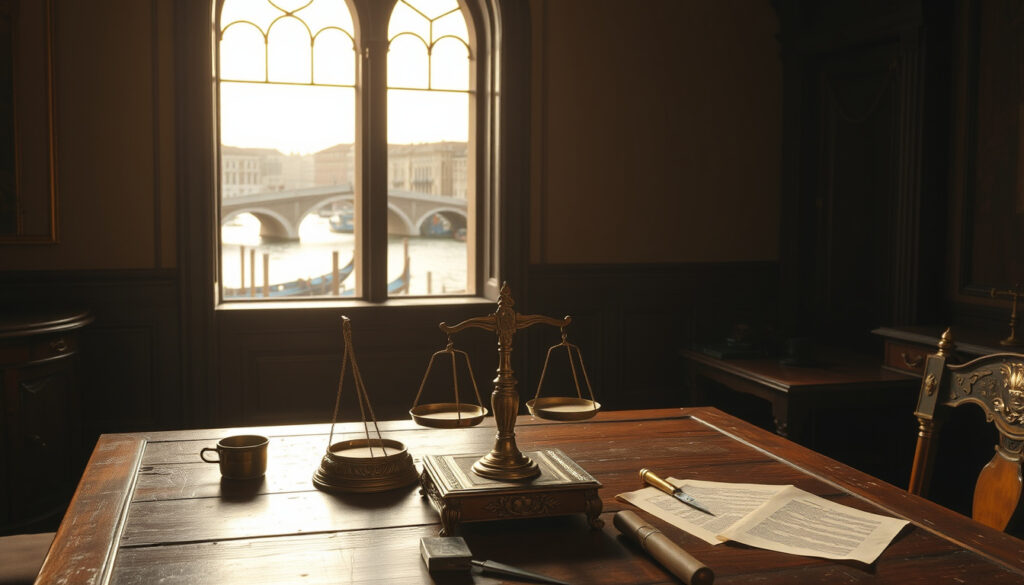
The Merchant of Venice: Summary, Controversy, and Famous Quotes
In the late 1590s, Shakespeare wrote a play that has never stopped arguing with its audience — and four centuries later it still refuses to say who is right. Here is what happens in The Merchant of Venice, where its most famous lines come from, and why the question of Shylock’s villainy refuses to settle.
Year written: 1596–1598 · First performance: c. 1605 · Setting: Venice and Belmont · Protagonist: Antonio, Bassanio, Portia · Antagonist: Shylock (ambiguous) · Famous phrase: “A pound of flesh”
Quick snapshot
- Antonio borrows money from Shylock so Bassanio can court Portia (Emory University (Shakespeare and the Players)).
- Shylock’s bond demands a pound of Antonio’s flesh if the loan defaults (Encyclopaedia Britannica (reference work)).
- Bassanio wins Portia by choosing the lead casket (Emory University (Shakespeare and the Players)). (Emory University (Shakespeare and the Players))
- Portia argues the bond allows flesh, but no blood (Smithsonian Magazine (history and culture)).
- Whether Shakespeare intended an anti-Semitic portrayal or a sympathetic one (Smithsonian Magazine (history and culture)). (University of Groningen (academic research))
- Whether Shylock is a villain or a victim of Christian prejudice (University of Groningen (academic research)).
- Whether the play is best labeled a comedy or a tragedy (University of Groningen (academic research)). (University of Groningen (academic research))
- Written between 1596 and 1598 (Encyclopaedia Britannica (reference work)).
- First performed c. 1605 (Encyclopaedia Britannica (reference work)).
- Read the trial scene and watch how quickly mercy turns into a legal trick.
- See a production — or Michael Radford’s film adaptation — and track how Shylock is played.
- Decide whether the ending celebrates justice or documents a forced conversion.
Eight rows, one pattern: every relationship in the play is a contract — of money, love, or law — and someone always tries to collect.
| Fact | Detail |
|---|---|
| Author | William Shakespeare |
| Year written | 1596–1598 (Encyclopaedia Britannica (reference work)) |
| Genre | Comedy (with tragic elements) |
| Setting | Venice, Italy, and Belmont |
| Main characters | Antonio, Bassanio, Portia, Shylock, Jessica |
| Shylock’s bond | A pound of Antonio’s flesh |
| Trial turning point | The bond allows flesh, but no blood |
| Shylock’s fate | Property loss and forced conversion |
The pattern holds: even the love stories run on credit, and the one character who takes the contract literally loses everything.
What is The Merchant of Venice about?
The simplest description makes it sound like a con: friendship, money, and a debt that turns lethal. That is the engine of the play — and everything else happens inside that collision.
What is the main message of the play?
- Antonio, a Venetian merchant, borrows money from Shylock so his friend Bassanio can court Portia (Emory University (Shakespeare and the Players)).
- Shylock’s contract requires a pound of Antonio’s flesh if the loan is not repaid — and when Antonio’s ships are reported lost, the bond comes due (Encyclopaedia Britannica (reference work)).
- At Belmont, Portia’s dead father’s will forces suitors to choose among gold, silver, and lead caskets; Bassanio chooses lead and wins her hand (Emory University (Shakespeare and the Players)).
Portia’s courtroom move is the hinge of the plot. Disguised as a male lawyer, she argues that Shylock may take his pound of flesh but not a drop of Antonio’s blood — a ruling that saves Antonio and turns the law against Shylock (Smithsonian Magazine (history and culture)).
“This bond doth give thee here no jot of blood; the words expressly are ‘a pound of flesh.’” — Portia, The Merchant of Venice (Smithsonian Magazine (history and culture))
The play’s main message lives in that moment: mercy is what makes law survivable. Without it, justice collapses into violence — and Shylock, who demanded the letter of the law, is the first one crushed by it.
What is the setting and time period?
- Venice, where Antonio’s merchant business and Shylock’s lending trade sit uneasily side by side.
- Belmont, Portia’s estate — the romantic counterweight to Venice’s courts and counting houses.
Shakespeare wrote the play between 1596 and 1598 (Encyclopaedia Britannica (reference work)), and he set it in a city his audience already associated with commerce and foreigners. Belmont is the escape route: the place where money problems are supposed to end in marriage instead of court.
Venice is where contracts matter; Belmont is where appearances matter. The play keeps insisting they are the same place.
The play keeps both plots running until the trial fuses them.
What is the most famous line from The Merchant of Venice?
Two speeches have outlived the plot itself. One pleads for mercy; the other demands a hearing for a man the play has already condemned.
What is Portia’s ‘The quality of mercy’ speech?
- The “quality of mercy” speech is one of the most quoted passages in English literature (Emory University (Shakespeare and the Players)).
- Portia delivers it in the trial scene, disguised as a male lawyer, moments before she springs the no-blood trap (Smithsonian Magazine (history and culture)).
“The quality of mercy is not strained; it droppeth as the gentle rain from heaven upon the place beneath.” — Portia, The Merchant of Venice (Emory University (Shakespeare and the Players))
The speech frames the play’s central argument: mercy seasons justice, and without mercy the law becomes a blade. Shylock is still whetting his when Portia speaks.
What is Shylock’s ‘Hath not a Jew eyes?’ speech?
- The speech asks a courtroom full of Christians whether a Jew does not share the same senses, injuries, and desires (University of Groningen (academic research)).
- The speech has anchored scholarly debates about whether the play is anti-Semitic (Smithsonian Magazine (history and culture)).
“Hath not a Jew eyes? Hath not a Jew hands, organs, dimensions, senses, affections, passions?” — Shylock, The Merchant of Venice (University of Groningen (academic research))
The speech does not erase the stereotypes around Shylock. It makes them harder to repeat without hearing his voice — which is why it has anchored debates about the play for a century.
The contrast between the two speeches is the play in miniature: Portia asks for mercy, Shylock asks for recognition, and the play stages both without declaring a winner.
The pattern: Portia’s mercy is offered before the trap is sprung; Shylock’s humanity is asserted after the verdict is already in.
Why is The Merchant of Venice so controversial?
No Shakespeare play sits less comfortably in a modern classroom. The controversies are not hiding in the subtext; they are the text.
What is the anti-Semitism in the play?
- Shylock is a Jewish moneylender whose role draws on anti-Semitic stereotypes but surrounds them with “unusually humanizing material” (University of Groningen (academic research)).
- Before he proposes the bond, Shylock recalls repeated insults and mistreatment from Antonio, including public contempt for his faith and trade (Emory University (Shakespeare and the Players)).
- Scholars still disagree about whether the play endorses anti-Semitism or exposes it (Smithsonian Magazine (history and culture)).
The hardest part for modern readers is the ending. Shylock loses most of his property and is forced to convert to Christianity as a condition of keeping the rest (Encyclopaedia Britannica (reference work)). For many audiences, that conversion is not a happy ending; it is where comedy curdles.
Stage Shylock as a villain and you revive the play’s cruelty; stage him as a victim and you flatten its sharp edges. Modern productions keep getting caught in that gap.
What is the homosexuality subtext?
- Scholars and directors have long debated the nature of Antonio’s attachment to Bassanio, and the question now shapes modern productions (Smithsonian Magazine (history and culture)).
- Antonio never marries, while Bassanio chooses Portia — an asymmetry the play never explains.
- Directors keep returning to the bond between the two men because the text leaves it deliberately unresolved.
You do not need to commit to a queer reading to notice the emotional accounting: Antonio risks his flesh and fortune for Bassanio, and the play never quite pays him back. That silence is the subtext — and the reason the question keeps returning.
Is Portia racist?
- In the casket scenes, Portia makes openly dismissive comments about the Prince of Morocco’s dark skin.
- Her remarks are often cited as proof that the play’s prejudices are not only about religion.
Portia is the play’s heroine, its sharpest thinker, and also its most uncomfortable mirror: brilliant and bigoted in the same scene. That contradiction is exactly what keeps the play controversial.
The pattern: every major character here is both sympathetic and compromised — which is why the controversy is not a flaw but the point.
The catch: every attempt to settle the play’s moral accounting only renews it.
Who is the real villain in The Merchant of Venice?
Four centuries of actors have not settled this one. The text keeps both options open — and that is why the role is considered one of Shakespeare’s greatest.
Why did Shylock dislike Antonio?
- Shylock’s own account is specific: Antonio has spat on him, kicked him, and insulted his usury in public (Emory University (Shakespeare and the Players)).
- Antonio’s contempt is religious and economic at once — and Shylock remembers every instance.
Shylock’s grievance speech is the play’s great accounting: he lists the abuses, then proposes a bond that lets the law do what Antonio’s manners already did. Revenge, in other words, wearing a contract’s clothes.
Is Shylock a sympathetic character?
- Shylock’s role mixes anti-Semitic stereotype with unusually humanizing material that can evoke sympathy (University of Groningen (academic research)).
- The “Hath not a Jew eyes?” speech is the clearest bid for that sympathy.
- His insistence on the bond turns the courtroom against him (Smithsonian Magazine (history and culture)).
For centuries, actors played Shylock as a villain; after the Holocaust, most productions reversed the reading (Smithsonian Magazine (history and culture)). The text supports both — which is exactly what makes the role so durable.
Are Antonio and Bassanio morally ambiguous?
- Antonio is the title character, a celebrated Christian merchant — and a man who treats Shylock with open contempt.
- Bassanio needs money to court Portia, which gives his friendship with Antonio a financial edge (Emory University (Shakespeare and the Players)).
- The court that Portia maneuvers still ends by stripping Shylock of his property and faith (Encyclopaedia Britannica (reference work)).
The real villain case is strongest against nobody in particular — which is the point. Christian Venice treats Shylock as an outsider, takes his money, and calls it justice.
The implication: the play’s villainy is distributed, not owned. Shylock is cruel; Antonio is smug; Bassanio is a borrower; Portia is a brilliant trickster. Choosing one villain means choosing what you are willing to overlook in the others.
The verdict the play refuses to deliver is the one it forces audiences to supply.
What is the main message of Merchant of Venice?
Ask ten critics and you will get ten messages: mercy, money, prejudice, performance. The play stacks them all on the same scale.
What does the play say about mercy and justice?
- The trial pits Shylock’s demand for the letter of the law against Portia’s plea for mercy (Smithsonian Magazine (history and culture)).
- The “quality of mercy” speech remains a touchstone in debates about punishment and forgiveness (Emory University (Shakespeare and the Players)).
Mercy, in Portia’s framing, is not softness; it is what stops justice from becoming violence. The play tests that idea by giving Shylock zero mercy at the end.
What about love and friendship?
- The happy couplings — Bassanio and Portia, Nerissa and Gratiano — follow the casket test and its parallel wager plot (Emory University (Shakespeare and the Players)).
- Antonio’s bond with Bassanio is the play’s deepest relationship and the one with no wedding at the end.
Friendship in this play is never free: it is paid in money, in flesh, or in silence. Bassanio gets the bride; Antonio gets a rescue; Shylock gets the bill.
Is it a comedy or tragedy?
- The play ends with marriages and a ring, the standard furniture of Shakespearean comedy.
- But Shylock’s forced conversion and ruin give the ending a tragic weight that the comic form strains to contain (Encyclopaedia Britannica (reference work)).
- Scholars and directors keep reclassifying the play; the label depends on how Shylock is played (University of Groningen (academic research)).
The honest answer is that it is both, and the genre question is really an opinion about Shylock. Read him as a monster and the play is a comedy; read him as a man and it is something darker.
The classification determines what a production is actually saying: “comedy” forgives the ending, “tragedy” indicts it — and the play refuses to tell directors which is true.
Confirmed facts
- The play was written between 1596 and 1598 (Encyclopaedia Britannica (reference work)).
- Shylock is a Jewish moneylender who lends money at interest (Emory University (Shakespeare and the Players)).
- Portia delivers the “quality of mercy” speech (Emory University (Shakespeare and the Players)).
What’s unclear
- Whether Shakespeare intended Shylock as a villain or a victim (Smithsonian Magazine (history and culture)).
- The exact nature of Antonio and Bassanio’s relationship (Smithsonian Magazine (history and culture)).
- Whether the play is a comedy or a tragedy — the label changes with every production (University of Groningen (academic research)).
- Whether Jessica’s elopement with Lorenzo reads as liberation or betrayal (Encyclopaedia Britannica (reference work)).
None of this makes The Merchant of Venice easy to teach, easy to stage, or easy to enjoy — and the difficulty is the point. The play keeps demanding a verdict it refuses to deliver, which is exactly why it has survived every attempt to retire it. For anyone producing it or studying it, the decision is clear: confront the anti-Semitism head-on, or you end up performing it.
internetshakespeare.uvic.ca, en.wikipedia.org, rsc.org.uk, journals.sagepub.com
Frequently asked questions
What is the casket test in The Merchant of Venice?
Portia’s dead father left a will that requires suitors to choose among gold, silver, and lead caskets to win her hand. Bassanio picks the lead casket and wins (Emory University (Shakespeare and the Players)).
How does Portia save Antonio’s life?
Disguised as a male lawyer, she argues that Shylock’s bond entitles him to exactly one pound of flesh — but not a drop of blood — so literal enforcement is impossible (Smithsonian Magazine (history and culture)).
What happens to Shylock at the end of the play?
He loses most of his estate and is forced to convert to Christianity as the price of keeping part of it (Encyclopaedia Britannica (reference work)). Many productions stage the ending as a defeat, not a resolution.
Is The Merchant of Venice based on a true story?
No — the play is fiction. Shakespeare adapted the pound-of-flesh plot and the casket test from earlier European tales and fused them with a marriage comedy.
What does “pound of flesh” mean today?
It still means a debt or demand enforced with ruthless literalism, without regard for the human cost — a phrase that outlived the play’s courtroom (Encyclopaedia Britannica (reference work)).
Why does Antonio agree to Shylock’s bond?
He expects his trading ships to repay the loan long before the bond matures; when they are reported lost, the pound of flesh becomes collectible (Encyclopaedia Britannica (reference work)).
What is the role of Jessica in the play?
Jessica is Shylock’s daughter. She elopes with Lorenzo, taking money and valuables from her father’s household and deepening his sense of betrayal (Emory University (Shakespeare and the Players)).
How did audiences in Shakespeare’s time view Shylock?
Early performance records suggest Shylock was played as a stage villain and the play enjoyed itself as a comedy; the sympathetic reading became widespread much later (Smithsonian Magazine (history and culture)).
Related reading
- A Few Good Men: True Story, Famous Quotes and Cast Facts — another courtroom drama whose trial turns on a single unforgettable line.
- Who Wrote the Bible? Divine Inspiration and Human Scribes — for readers following the play’s questions about law, scripture, and interpretation.
The play’s questions outlive their answers.
More related posts
 Closing Dates for Slurry and Fertiliser Spreading in Ireland
 Zendaya and Tom Holland 2026: Relationship Timeline & News
 Upcoming Concerts in Ireland 2026: Full Calendar
 My Life with the Walter Boys: Books, Ending, TV Series
 Man Utd v Newcastle: Preview, Lineups, and Key Stats 2026
 Text & Tests 2: Complete Guide to the Junior Cycle Maths Textbook
 Galaxy J Series to Buy 2025: Refurbished Guide
 Declan Breslin Donegal Tenancy Damages: €15k Tribunal Ruling