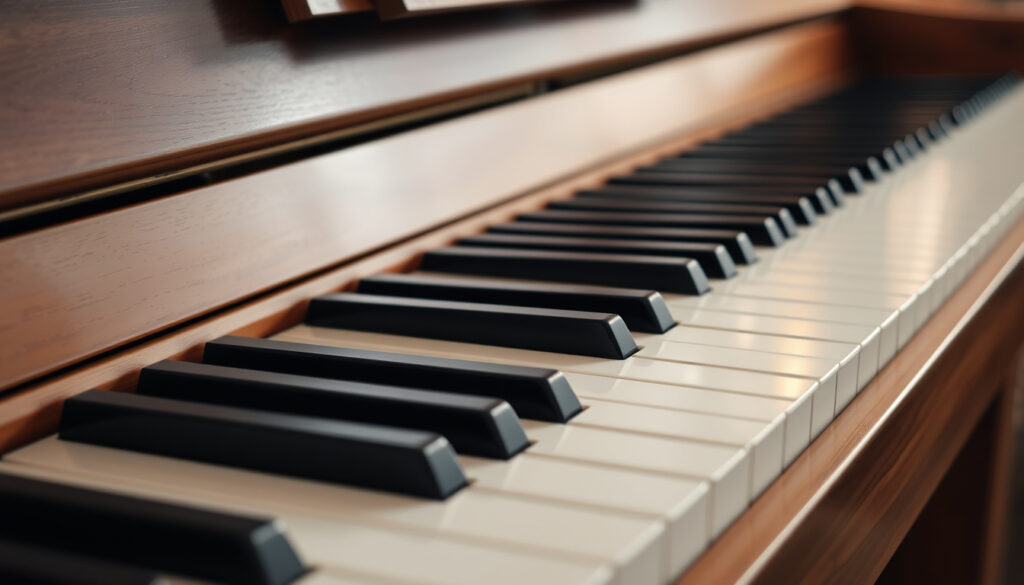
How Many Keys on a Piano? 88 Key Standard Explained
You’ve probably sat down at a piano — maybe at a friend’s house or a hotel lobby — and wondered just how many keys make up that big black-and-white array. A full-size piano has exactly 88 keys: 52 white and 36 black (Hoffman Academy (piano education resource)). That standard has held for over a century, yet many beginners start on compact 61-key keyboards. Here’s how the key count affects what you can play and which instrument fits your needs.
Standard piano keys: 88 · White keys: 52 · Black keys: 36 · Typical keyboard keys: 61 · Octave range: 7¼ · Frequency range: 27.5 Hz – 4,186 Hz
Quick snapshot
- 52 white keys (Hoffman Academy)
- 36 black keys (Hoffman Academy)
- 7¼ octaves (Hoffman Academy)
- 61 keys common on digital keyboards (Yamaha (piano manufacturer))
- Compact and portable design (Yamaha)
- 61 keys sufficient for pop/rock repertoire (Sam Ash (music instrument retailer))
- 88 keys needed for advanced classical pieces (Living Pianos (piano expert))
- Budget and space trade‑offs are real (Sam Ash)
- Advanced pieces (Debussy, Ravel) may need 88 keys (Living Pianos)
- Pop songs often fit comfortably on 61 keys (Sam Ash)
| Specification | Value | Source |
|---|---|---|
| Total keys | 88 | Hoffman Academy |
| White keys | 52 | Hoffman Academy |
| Black keys | 36 | Hoffman Academy |
| Octave range | 7¼ | Hoffman Academy |
| Frequency range (lowest to highest) | 27.5 Hz – 4,186 Hz | Yamaha |
| Standard established | 1890s | Living Pianos |
How Many Keys Are on a Full-Size Piano?
The 88-key layout wasn’t always the norm. Early pianos in the 18th century had as few as 60 keys. By the 1880s, most pianos offered 85 keys (7 octaves). But by the 1890s, manufacturers like Steinway helped establish 88 keys as the standard (Living Pianos). Today, any full-size acoustic or digital piano uses that same 88-key range, from A0 to C8.
How Many White Keys Are on a Piano?
- 52 white keys cover the natural notes: A, B, C, D, E, F, G repeated across octaves (Hoffman Academy).
- Each octave contains 7 white keys.
How Many Black Keys Are on a Piano?
- 36 black keys arranged in alternating groups of 2 and 3 (Hoffman Academy).
- Each octave contains 5 black keys (C♯/D♭, D♯/E♭, F♯/G♭, G♯/A♭, A♯/B♭).
The 88-key standard means you can play virtually any written piano score without missing a note. Drop to 61 keys and you lose more than a quarter of the range — enough to cut off the lowest bass notes of a Chopin nocturne or the highest runs of a Liszt etude.
Do I Need 61 or 88 Keys?
This is the most common fork in the road for new players. The answer depends on your musical goals, budget, and available space. Here’s how the two options stack up for beginners.
Is 61 Keys Good for Beginners?
Yes — for many beginners, 61 keys are enough to start. Retailer Sam Ash (music instrument retailer) notes that 61-key keyboards cover the range needed for popular songs, rock, and basic classical exercises. They are also lighter and far less expensive than full-size digital pianos. Some online forums report that early-level method books can be completed entirely on a 61-key instrument (Reddit discussion (piano learning community)).
Are 61 Keys Enough to Learn Piano?
If you plan to play mostly pop, rock, or contemporary music, 61 keys are likely sufficient for years. But if you ever want to tackle classical repertoire — especially pieces by composers like Debussy or Ravel — you will eventually need the full 88 keys (Living Pianos). The trade-off is real: starting on a 61-key keyboard may mean upgrading later, whereas an 88-key instrument grows with you.
Should a Beginner Use 61 or 88 Keys?
- Choose 61 keys if: budget is tight, space is limited, and you want to explore music casually or focus on pop/rock.
- Choose 88 keys if: you have room for a larger instrument, you want weighted keys for realistic feel, and you intend to learn classical or jazz seriously (Yamaha).
A 61-key keyboard typically lacks weighted keys, so the finger strength you build won’t transfer perfectly to an acoustic piano. If your long-term goal is to play on a real grand, start with 88 weighted keys — even a compact digital like the Yamaha P-145.
How Many Keys on a Piano vs Keyboard?
The terms “piano” and “keyboard” are often used interchangeably, but they refer to different instruments with different key counts and touch characteristics.
How Many Keys on a Keyboard?
Digital keyboards are available in several key counts: 61, 76, or 88 keys. The most common entry-level size is 61 keys (Pianote (online piano learning platform)). These instruments are designed for portability and often include built-in sounds, rhythms, and teaching features (Cahayamusic (music instrument information)).
How Many Keys on an Organ?
Organs typically have 61 keys per manual (keyboard). A standard pipe organ or digital organ has two or three manuals, each with 61 keys. Organ keys are usually unweighted and lighter than piano keys, suited for rapid passages and stops.
| Instrument | Typical Key Count | Key Action |
|---|---|---|
| Acoustic piano (grand/upright) | 88 | Weighted |
| Digital piano (88-key) | 88 | Weighted or hammer action |
| Digital keyboard (entry-level) | 61 | Unweighted / semi-weighted |
| Keyboard (intermediate) | 76 | Unweighted or semi-weighted |
| Organ (per manual) | 61 | Unweighted |
The pattern: key count and action type are tied directly to the instrument’s intended use — portability for keyboards, weighted feel for pianos.
What Is the Hardest Key to Play In?
Musicians sometimes debate which key signature is the hardest. Key signatures with many sharps or flats — such as C♯ major (7 sharps) or F♯ major (6 sharps) — require more physical awkwardness on the keyboard because the black keys are used heavily. Beginners almost always start in easy keys like C major (no sharps/flats) or G major (1 sharp). But difficulty is subjective: a skilled player may find F♯ major comfortable depending on the piece and hand shape.
For most learners, the hardest key is the one they haven’t practiced enough. No single key is universally hardest — it depends on repertoire and individual technique.
What Are the Most Popular Piano Songs Ever?
Certain piano pieces have crossed over into popular culture and remain endlessly beloved. According to lists compiled by online piano platforms, consistent favorites include Beethoven’s “Für Elise,” Debussy’s “Clair de Lune,” and Yiruma’s “River Flows in You” (Pianote (piano learning resource)).
What Is Considered the Most Beautiful Piano Song Ever?
That’s a matter of personal taste, but “Clair de Lune” frequently tops listener polls for its delicate, impressionistic beauty. Other strong contenders include Chopin’s Nocturnes, “Comptine d’un autre été” by Yann Tiersen, and modern pieces by Ludovico Einaudi.
61-Key vs 88-Key: Side-by-Side Comparison
Two common options, one key difference: range. Here is how they compare across the factors that matter most to a buyer.
| Feature | 61-Key Keyboard | 88-Key Piano |
|---|---|---|
| Total keys | 61 | 88 |
| Octave range | 5 octaves | 7¼ octaves |
| Weighted keys | Usually no | Yes (most models) |
| Portability | Light, fits in car trunk | Heavy, requires dedicated space |
| Best for | Pop, rock, beginner exercises | Classical, jazz, all genres |
| Price range (entry) | $100–$300 | $400–$1,000+ |
The implication: 61 keys offer a low-cost entry point, but 88 keys future-proof your playing across the full musical spectrum.
Piano Keyboard Specifications
Six key specs that define a modern piano keyboard — and why each number matters when choosing an instrument.
| Specification | Value | Significance |
|---|---|---|
| Total keys | 88 | Covers full range of written piano music |
| White keys | 52 | Natural notes; seven per octave |
| Black keys | 36 | Sharps and flats; five per octave |
| Octave span | 7¼ | From A0 to C8 |
| Lowest frequency | 27.5 Hz | Lowest A on piano |
| Highest frequency | 4,186 Hz | Highest C on piano |
The pattern: every spec is tied to the acoustic range of the instrument — the 88-key layout is not arbitrary but designed to cover the audible spectrum for musical performance.
Pros and Cons: 61-Key Keyboard vs 88-Key Piano
Upsides
- 61-key: affordable, portable, great for pop and early learning (Sam Ash)
- 61-key: built-in teaching features on many models (Cahayamusic)
- 88-key: weighted keys build proper finger strength (Yamaha)
- 88-key: full range for any musical genre
Downsides
- 61-key: unweighted keys feel different from acoustic piano
- 61-key: missing bass notes and high treble for classical pieces
- 88-key: heavier and more expensive
- 88-key: requires dedicated floor space
The trade-off: 61 keys sacrifice range and feel for cost and convenience. 88 keys deliver the real piano experience at a higher price.
Confirmed Facts vs What’s Unclear
Confirmed facts
- An 88‑key piano has 52 white and 36 black keys (Hoffman Academy).
- The 88‑key standard became established by the 1890s (Living Pianos).
- 61‑key keyboards lack the full range of an 88‑key piano (Yamaha).
What’s unclear
- Why exactly 88 keys was chosen over other possible counts – speculation about the human ear’s range is widely cited but not definitively proven.
Expert Perspectives
By the 1890s, today’s modern keyboard had become established with 88 keys spanning 7¼ octaves (from 2A to C5; 27.5 Hz to 4,186 Hz).
— Yamaha Musical Instrument Guide
How many keys are on a piano? A typical piano has 36 black keys and 52 white keys. That’s 88 piano keys total.
— Hoffman Academy Blog
For anyone starting their musical journey, the choice between 61 and 88 keys comes down to ambition: stick with pop and basic exercises, and 61 keys will serve you well for years. But if classical repertoire or full dynamic expression is the goal, an 88-key piano is the only way to avoid hitting a ceiling. For the beginner in the US market, the trade-off is clear: invest in an 88-key instrument from the start, or accept the limitations of a 61-key keyboard and plan to upgrade later.
partykeys.com, facebook.com, youtube.com, reddit.com, reddit.com
Frequently asked questions
Why do pianos have 88 keys?
The 88-key standard was cemented in the 1890s to cover the full range of written piano music, from the lowest A to the highest C, spanning 7¼ octaves.
Can you play all songs on a 61-key keyboard?
No. Many classical and advanced pop pieces require notes outside the 61-key range, especially in the bass and high treble. However, most pop and beginner pieces fit within 61 keys.
Are there pianos with more than 88 keys?
Yes, but they are rare. Some Bösendorfer imperial grand pianos have 97 keys (9 extra bass keys). Most music is written for the standard 88-key range.
How many keys does a baby grand piano have?
All standard grand pianos, including baby grands, have 88 keys. The difference is in the string length and soundboard size, not the key count.
What is the difference between weighted and unweighted keys?
Weighted keys simulate the resistance of an acoustic piano hammer action. Unweighted keys are lighter and springier, common on cheap keyboards. Weighted keys help build proper finger technique.
How many keys do I need to play ‘River Flows in You’?
Yiruma’s “River Flows in You” can be played on a 61-key keyboard because its range stays just over 5 octaves. Always check the score — some arrangements may extend beyond.
Is a 61-key keyboard good for a child beginner?
Yes. A 61-key keyboard is light, affordable, and enough for early lessons. Many children graduate to 88 keys after a couple of years if they stick with piano.
Related reading
More related posts
 Johnson & Perrott Cork: Locations, Brands, Reviews & Contact Info
 Best Group Exercises at Home: 7-7-7 Rules & Big 7 Movements
 Houses for Sale Near Me: Cheapest Locations & Timing in 2026
 Zummi Eden Compact Stroller Review: Lightweight Easy Fold
 Size 37 in UK: EU 37 to UK Shoe Size
 Royal Caribbean Cruises 2026: Cheapest Month, Tips & Rules
 Boots Portlaoise Opening Hours & Pharmacy Services
 The Telegraph Building Belfast – Events, Tickets, Capacity Guide