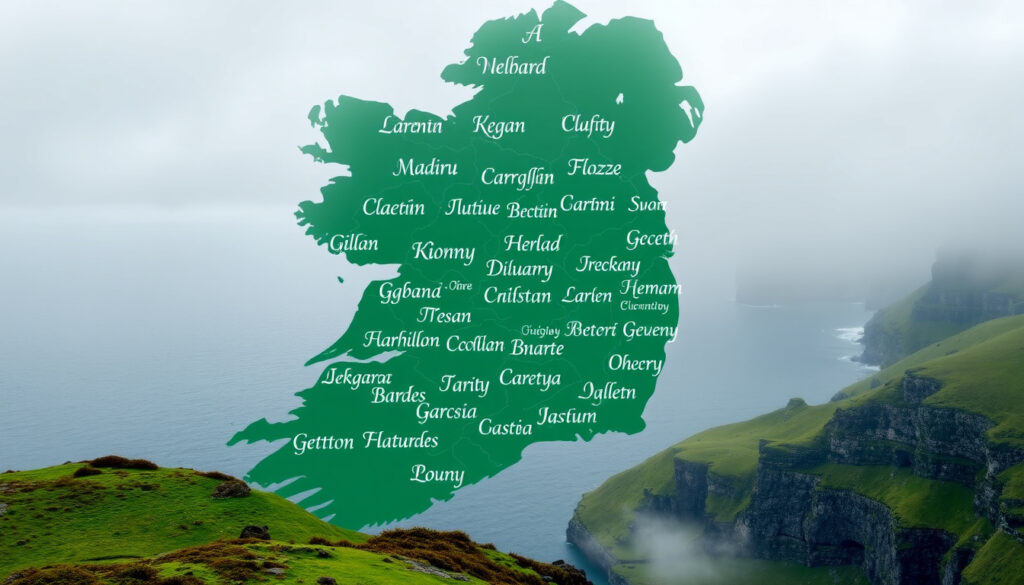
Counties of Ireland in Irish – Official Names for 32 Counties
Ireland’s 32 traditional counties each carry a distinct Irish Gaelic name, a linguistic heritage that reflects centuries of cultural continuity despite political division. These Gaelic designations, known as contaeanna na hÉireann, represent more than simple translations—they embody the historical territories, local saints, chieftains, and geographical features that shaped Irish identity long before English became the dominant administrative language.
The standardized Irish names derive from the Placenames Database of Ireland, an authoritative source maintained by the Irish government. This database, accessible through Logainm.ie, establishes official Gaelic forms for all 32 historic counties, ensuring consistency across education, government documentation, and increasingly on road signage throughout the Republic.
What Are the Counties of Ireland Called in Irish?
The complete list of counties in Irish Gaelic encompasses all 32 traditional divisions that originated before 1838. Each name carries etymological significance, often rooted in geographic features, historical rulers, or religious figures central to local identity.
Traditional Counties
Republic of Ireland
Northern Ireland
Provinces
All 32 traditional counties possess standardized Irish names established through official government channels. The naming system groups counties into four provinces: Connacht, Leinster, Munster, and Ulster. Provincial divisions in Irish are called cúigí. Most English county names derive directly from Irish forms, though three notable exceptions—Waterford, Wexford, and Wicklow—carry Norse rather than Gaelic origins.
- Official Irish names are maintained by the Placenames Database of Ireland
- The Gaelic revival has increased usage of Irish names on official signage since the 2000s
- Provinces represent historic cúigí: Connacht, Leinster, Munster, and Ulster
- County names often reference historical kings, chieftains, or geographic features
- Dublin, while administratively divided today, retains its status among the 32 traditional counties
- Ulster’s nine counties straddle both Northern Ireland and the Republic
The 32 Traditional Counties
| English Name | Irish Gaelic Name | Province |
|---|---|---|
| Galway | Gaillimh | Connacht |
| Mayo | Maigh Eo | Connacht |
| Roscommon | Ros Comáin | Connacht |
| Sligo | Sligeach | Connacht |
| Leitrim | Lítrím | Connacht |
| Dublin | Baile Átha Cliath | Leinster |
| Wexford | Loch Garman | Leinster |
| Cork | Corcaigh | Munster |
| Kerry | Ciarraí | Munster |
| Donegal | Dún na nGall | Ulster |
| Derry/Londonderry | Doire | Ulster |
How Many Counties Are There in Ireland?
Ireland contains 32 traditional counties, though the political division between the Republic of Ireland and Northern Ireland affects how these are counted and administered. The distinction between historic counties and modern administrative units creates important nuances for anyone studying Irish geography and governance.
Republic of Ireland (26 Counties)
The Republic of Ireland encompasses 26 of the 32 traditional counties. These divisions remain culturally significant despite administrative reforms that created 26 to 31 local government units depending on how Dublin’s subdivisions are counted. County names in Irish appear frequently on official documents, educational materials, and increasingly on road signage throughout the Republic. The government has actively promoted Gaelic place names as part of broader language revitalization efforts, with mandates for bilingual signage implemented through the 2000s.
Northern Ireland (6 Counties)
Northern Ireland contains six of Ireland’s traditional counties: Antrim, Armagh, Down, Fermanagh, Londonderry/Derry, and Tyrone. These designations remain culturally important within Northern Ireland, though administrative reorganization has replaced county councils with district councils. Irish Gaelic names for these counties appear in various contexts, though usage patterns differ from the Republic due to different political priorities regarding language promotion.
The Irish names for Northern Ireland’s counties follow the same etymological patterns as southern counties. For instance, Tír Eoghain translates to “land of Eoghan,” honoring the historical chieftain from whom the territory took its name.
Why Do Irish Counties Have Gaelic Names?
The county system in Ireland predates English administrative dominance. Counties were established during the Anglo-Norman period in the late 12th and early 13th centuries, yet they were named using Irish Gaelic terminology that had existed for centuries as tribal and territorial designations. When the British standardized county boundaries before 1838, they preserved many existing Gaelic names rather than imposing entirely new English designations.
This continuity means that most English names for Irish counties are actually anglicized versions of Irish Gaelic originals. The names encode historical information about local geography, saints, kings, and tribal affiliations. For example, County Kerry derives from Ciarraí, referencing the tribe of Ciar, while County Limerick comes from Luimneach, possibly connected to the legendary figure Lugh or a Viking name for the region.
Three counties break the Gaelic naming pattern: Waterford (Port Láirge), Wexford (Loch Garman), and Wicklow (Cill Mhantáin). These names contain Norse elements, reflecting the Viking settlements that predated Norman influence in those areas.
Origins and Evolution of County Names
The standardization of Irish place names gained formal recognition during the 20th century as part of broader language preservation efforts. The Placenames Commission, established under the Official Languages Act 2003, now maintains authoritative records through the Logainm.ie database. This resource serves as the definitive reference for standardized Irish names across education, government, and media.
Provincial divisions represent Ireland’s oldest territorial organization, predating the county system by centuries. The four provinces—Connacht, Leinster, Munster, and Ulster—each contain distinct county groupings. Ulster, notably, spans both political jurisdictions, with three of its nine counties lying within the Republic while six belong to Northern Ireland.
Timeline: Key Moments in County Name Standardization
- Pre-1922: The island maintains 32 counties under British administration
- 1921-1922: Partition creates separate jurisdictions while preserving county designations
- 1960s: Irish government begins systematic standardization of Gaelic place names
- 2000s: Official mandates require bilingual signage on public roads and buildings
What Is Established Versus Uncertain?
| Established Information | Areas of Uncertainty |
|---|---|
| 32 traditional counties with fixed Irish names maintained by government databases | Some historical name variants; debate over certain etymological interpretations |
| 26 counties in the Republic, 6 in Northern Ireland | Future administrative reorganizations may affect official designations |
| Four provinces: Connacht, Leinster, Munster, Ulster | Regional variations in pronunciation and local dialect forms |
The Role of Counties in Irish Culture
Beyond administrative convenience, counties define Irish regional identity in ways that transcend formal governance. The Gaelic Athletic Association (GAA) organizes its activities along county lines, making these territorial designations central to community sports culture. Hurling and Gaelic football competitions pit counties against each other, fostering fierce local pride and loyalty that connects modern Irish people to their historic territorial roots.
Education systems reinforce county identity through curriculum content that teaches local history and geography. Children learn the Irish names for their home counties early in schooling, and this knowledge forms part of broader cultural literacy. The survival of these Gaelic designations through centuries of political change demonstrates the resilience of indigenous naming traditions against external pressures.
The county names preserved in Irish represent a direct linguistic link to the island’s pre-Norman past. They encode geography, history, and identity in ways that transcend simple translation.
— Placenames Database of Ireland documentation
Summary
The 32 counties of Ireland in Irish—contaeanna na hÉireann—represent a living linguistic heritage maintained through official standardization efforts. Whether examining cultural artifacts or simply reading road signs, these Gaelic names connect contemporary Ireland to centuries of continuous tradition. The division between the Republic’s 26 counties and Northern Ireland’s 6 counties reflects political reality rather than cultural division, as both jurisdictions preserve these historic designations within their respective systems.
Frequently Asked Questions
Is there a map of counties with Irish names?
Maps showing counties alongside their Irish Gaelic names are available through educational resources and government databases. The Logainm.ie website provides interactive access to standardized place names across all 32 counties.
What is the Irish name for County Kerry?
The Irish name for County Kerry is Ciarraí, derived from the tribal name of the ancient kingdom of Ciar.
How are Irish county names officially recorded?
The Placenames Database of Ireland (Logainm.ie) serves as the authoritative source for standardized Irish place names, including all 32 county designations.
Why do some county names differ significantly between English and Irish?
Most county names share common etymological roots, but significant differences occur when English preserves Norse or Norman influences while Irish reflects older Gaelic forms. This is visible in counties like Wexford, where Irish (Loch Garman) and English names diverge substantially.
Are the Irish names for counties used on road signs?
Bilingual signage displaying Irish and English county names is mandatory on roads throughout the Republic of Ireland. Usage in Northern Ireland varies by location and local policy.
What does Ulster mean in Irish?
Ulster is one of Ireland’s four historic provinces. In Irish Gaelic, it is known as Ulaidh, representing one of the original cúigí or fifths into which the island was historically divided.
More related posts
 Houses for Sale in Sandymount: 2025 Market Guide
 Tomorrow’s Catholic Mass Readings and Reflection Guide
 How to Save on Grocery Shopping: 5-4-3-2-1 Method
 Tottenham vs West Ham: Results, Stats & How to Watch
 Goa vs Al-Nassr: Score, Ronaldo Absence, and Match Facts
 What Is a Thermos? Definition, Uses, and How It Works
 US to UK Shoe Size Conversion Chart: Men, Women, Kids