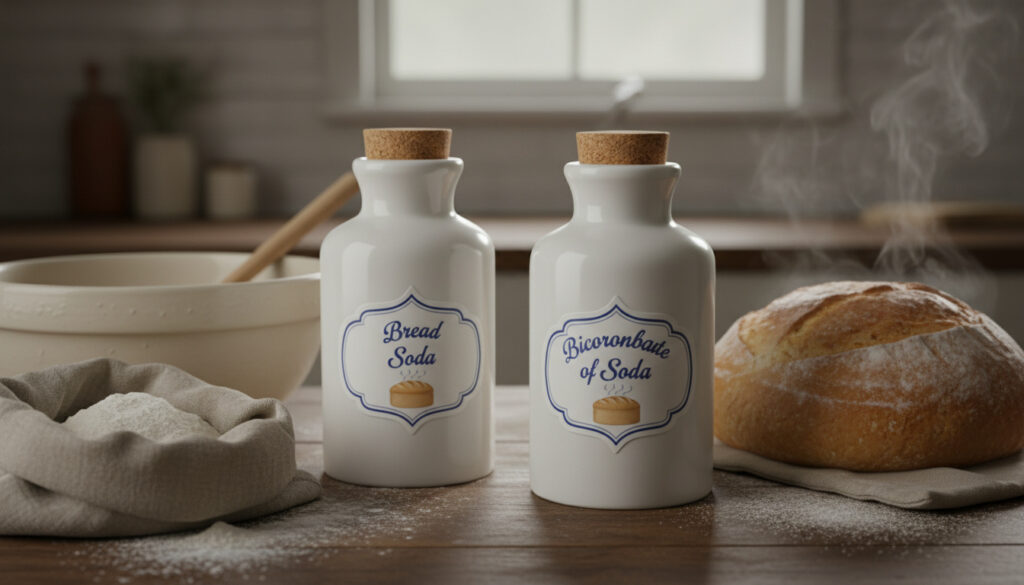
Is Bread Soda the Same as Bicarbonate of Soda – Yes, Full Guide
Bread soda and bicarbonate of soda are chemically identical. Both names describe pure sodium bicarbonate (NaHCO₃), a white alkaline powder that produces carbon dioxide gas when combined with acidic ingredients to leaven baked goods.
In Ireland and the United Kingdom, “bread soda” remains the traditional terminology for this leavening agent, particularly in recipes for Irish soda bread where it reacts with acidic buttermilk. Elsewhere, the same substance appears as “bicarbonate of soda,” “baking soda,” or simply “sodium bicarbonate” on packaging labels.
Despite the unified chemical identity, confusion persists regarding substitutions, differences from baking powder, and appropriate usage ratios. This guide examines the factual basis for these interchangeable terms, clarifies distinctions from compound leavening agents, and provides practical guidance for culinary application.
Is Bread Soda the Same as Bicarbonate of Soda?
Pure Sodium Bicarbonate (NaHCO₃)
Bread Soda, Bicarb Soda, Baking Soda
Alkaline Leavening Agent
Prevalent in Irish and UK Baking Traditions
- Bread soda and bicarbonate of soda share an identical chemical structure with no compositional differences
- Both terms require acidic ingredients such as buttermilk, yogurt, or vinegar to activate leavening
- The designation “bread soda” specifically references traditional Irish soda bread recipes
- All three primary names—bread soda, bicarbonate of soda, and baking soda—function interchangeably in recipes
- The substance appears as a fine white crystalline powder with a slightly alkaline taste
- Commercial production yields chemically pure NaHCO₃ regardless of regional branding
- Shelf stability averages three months when stored in dry conditions
| Property | Bread Soda | Bicarbonate of Soda | Technical Notes |
|---|---|---|---|
| Chemical Formula | NaHCO₃ | NaHCO₃ | Sodium hydrogen carbonate |
| Molecular Structure | Monoclinic crystals | Monoclinic crystals | White crystalline solid |
| pH (1% solution) | 8.3 | 8.3 | Weakly alkaline |
| Primary Components | 100% sodium bicarbonate | 100% sodium bicarbonate | No additives or fillers |
| Activation Requirement | Acid + moisture | Acid + moisture | CO₂ release upon reaction |
| Standard Usage | ¼ tsp per cup flour | ¼ tsp per cup flour | When paired with acid |
| Shelf Life | 3 months (opened) | 3 months (opened) | Test with vinegar for potency |
| Safety Classification | GRAS (FDA) | GRAS (FDA) | Generally recognized as safe |
| Synonymous Terms | Baking soda, soda crystals | Bicarb, cooking soda | Regional variations only |
| Primary Application | Quick breads, scones | Cakes, biscuits, cleaning | Culinary and domestic use |
What Is Bread Soda?
Chemical Composition and Physical Properties
Bread soda consists exclusively of sodium bicarbonate, an ionic compound with the formula NaHCO₃. This alkaline salt derives from the reaction of sodium carbonate with carbon dioxide and water. In its commercial form, it presents as a white, odorless crystalline powder with a molecular weight of 84.0066 g/mol according to chemical documentation.
As a leavening agent, it operates through acid-base chemistry. When combined with hydrogen ions from acidic ingredients—such as the lactic acid in buttermilk or acetic acid in vinegar—it produces carbon dioxide gas. This gas expansion creates the characteristic rise in dough and batter structures without requiring fermentation time.
Historical and Regional Terminology
The term “bread soda” emerged within Irish and British culinary contexts during the 19th century, coinciding with the widespread adoption of chemical leavening. Traditional Irish soda bread recipes, which predate commercial yeast availability in rural areas, established this nomenclature through generations of home baking. The The difference between bread soda, baking soda, and baking powder remains primarily semantic rather than substantive.
Laboratory analysis confirms that products labeled “bread soda” in Irish and UK markets contain 100% sodium bicarbonate with no proprietary additives or chemical modifications distinct from “bicarbonate of soda” sold elsewhere. Both substances originate from identical manufacturing processes regulated under the same food safety standards.
Can You Use Bread Soda as a Substitute for Bicarbonate of Soda?
Direct Substitution Parameters
Substitution requires no conversion calculations because the substances are identical. One teaspoon of bread soda equals one teaspoon of bicarbonate of soda in chemical potency and volumetric measurement. Recipes calling for either ingredient assume the presence of acidic components to neutralize the alkaline base and prevent bitter aftertastes.
When recipes specify baking powder rather than soda, conversion becomes necessary. Baking powder contains approximately 30% sodium bicarbonate combined with acidic salts and fillers. To substitute bread soda for baking powder, use one-third the specified amount of powder and add an acidic ingredient separately.
Practical Applications and Measurement Ratios
Standard culinary practice recommends approximately ¼ teaspoon of bread soda per cup of flour when acidic liquid is present. For buttermilk-based Irish soda bread, this ratio produces optimal rise without metallic flavors. What is the difference between bicarbonate of soda and baking powder extends beyond composition to activation timing, requiring different measurement approaches.
When replacing baking powder with bread soda, use a 1:3 ratio—one teaspoon of bread soda substitutes for three teaspoons of baking powder. Compensate by adding ½ to 1 teaspoon of lemon juice, vinegar, or cream of tartar per ½ teaspoon of bread soda to provide necessary acidity. This substitution increases leavening strength by approximately 300%.
Bread Soda vs Baking Powder: Key Differences
Compositional Distinctions
Baking powder comprises a complete leavening system containing sodium bicarbonate (approximately 30%), an acidic salt such as potassium bitartrate (cream of tartar), and a moisture-absorbing filler like cornstarch. This formulation enables “double action” leavening—initial gas release upon liquid contact and secondary expansion when heated. Bread soda, as pure sodium bicarbonate, lacks integrated acid and requires external acidic ingredients to function according to food science sources.
Activation Mechanisms and Timing
Bread soda initiates immediate chemical reaction upon contact with acid and moisture, necessitating prompt baking to capture gas bubbles. Baking powder offers delayed activation through heat-responsive acid components, providing greater flexibility in preparation timing. The comparative analysis of leavening agents indicates that bread soda produces approximately three to four times the gas volume per equivalent weight when fully neutralized.
Do not use bread soda and baking powder interchangeably without adjusting quantities and ingredients. Using bread soda in recipes designed for baking powder without adding acid results in unneutralized alkaline residue, producing bitter, soapy flavors and potential textural collapse. Conversely, substituting baking powder for bread soda in acidic recipes yields insufficient rise and metallic undertones.
How Did Bread Soda Usage Develop in Ireland and the UK?
- Pre-1840s: Bakers relied exclusively on yeast fermentation or sourdough starters, requiring extended preparation times unsuitable for rural households without consistent heat sources.
- 1846: John Dwight and Austin Church established the first commercial manufacturing of sodium bicarbonate in the United States, initiating global distribution of standardized chemical leaveners.
- Late 19th Century: Irish rural households adopted “bread soda” for daily baking, utilizing naturally acidic soured milk when refined yeast remained expensive or unavailable.
- 1860s-1900: British chemists developed commercial baking powders combining sodium bicarbonate with cream of tartar, offering convenience but less potency than pure soda for specific applications.
- Present Day: Traditional Irish soda bread recipes maintain the bread soda terminology, while commercial baking predominantly utilizes baking powder for neutral batters according to chemical documentation.
What Is Definitively Known vs. What Remains Uncertain?
| Established Information | Areas of Uncertainty or Variation |
|---|---|
| Bread soda and bicarbonate of soda are chemically identical (100% NaHCO₃) | Specific manufacturing date when “bread soda” branding first appeared in Ireland (sometime pre-1900, exact records unclear) |
| Both require acidic ingredients for leavening activation | Variability in particle size between commercial brands, potentially affecting dissolution rates (no significant chemical impact established) |
| Shelf life degradation occurs through moisture absorption and thermal decomposition | Precise temperature thresholds at which Irish vs. UK storage conditions affect longevity differently |
| Safe for consumption in standard baking quantities (FDA/EFSA GRAS status) | Comparative statistical data on preference for bread soda versus baking powder in contemporary Irish households |
Why Do Multiple Names Exist for the Same Ingredient?
Linguistic variation stems from regional commercial branding and culinary tradition rather than chemical differentiation. British and Irish manufacturers historically marketed sodium bicarbonate specifically for bread-making applications, emphasizing its role in quick breads rather than general household cleaning or antacid uses. This targeted branding created distinct regional terminology that persists despite global standardization.
Confusion with baking powder arises from functional overlap in leavening. While both substances produce carbon dioxide, their chemical requirements differ fundamentally. Culinary glossaries note that consumers frequently substitute these agents incorrectly, resulting in baking failures attributable to acidity imbalances rather than ingredient quality.
The coexistence of “bicarbonate of soda” and “baking soda” reflects British versus American English preferences, while “bread soda” represents a functional subset specific to culinary applications. Food safety authorities classify all variants under identical regulatory categories for sodium bicarbonate additives.
What Do Food Scientists and Culinary Experts Confirm?
Bread soda, bicarbonate of soda, baking soda, and sodium bicarbonate are all identical—pure sodium bicarbonate (NaHCO₃), a white crystalline powder used as a leavening agent in baking, particularly in Ireland and the UK for quick breads like Irish soda bread.
— Irish Soda Bread Way, culinary heritage documentation
Baking powder differs as a complete leavening mixture containing sodium bicarbonate plus an acid and a filler like cornstarch, while bread soda remains pure alkali requiring separate acidic ingredients for activation.
— World of Spice, food science analysis
Recipes may combine both bread soda and baking powder for extra lift in acidic batters, utilizing the soda to neutralize excess acid while the powder provides additional leavening through its heat-activated secondary reaction.
— Nigella Lawson, culinary expertise
What Should You Remember About Bread Soda and Bicarbonate of Soda?
Bread soda and bicarbonate of soda represent identical chemical compounds suitable for interchangeable use in all culinary applications. The terminology difference reflects regional naming conventions rather than compositional variation. When selecting leavening agents, distinguish carefully between pure sodium bicarbonate (bread soda/bicarbonate of soda) and compound baking powders, as substitution requires proportional adjustment and acid balance. For traditional Irish soda bread and other acidic doughs, The difference between bread soda, baking soda, and baking powder guides appropriate selection based on recipe chemistry rather than geographic origin.
Additional Questions About Bread Soda
Is bicarbonate of soda the same as baking soda?
Yes. Bicarbonate of soda and baking soda are identical terms for sodium bicarbonate (NaHCO₃). Both names describe the same pure alkaline compound used for leavening, cleaning, and antacid purposes. The terminology varies by region, with “baking soda” preferred in American English and “bicarbonate of soda” in British English.
Is bread soda safe to eat?
Yes, bread soda is safe for consumption in standard baking quantities. The FDA and EFSA classify sodium bicarbonate as “Generally Recognized As Safe” (GRAS). Excessive consumption may cause temporary alkalosis or gastrointestinal discomfort, and the high sodium content makes it unsuitable for low-sodium diets.
Where can I buy bread soda?
Bread soda is available in supermarkets throughout Ireland and the United Kingdom, typically located in the baking aisle. Internationally, it is sold as “baking soda” or “bicarbonate of soda” in grocery stores, pharmacies, and online retailers. Look for pure sodium bicarbonate without added ingredients.
Is bread soda the same as baking powder?
No. Bread soda is pure sodium bicarbonate, while baking powder contains sodium bicarbonate mixed with acidic salts and fillers. Bread soda requires added acid to activate, whereas baking powder is self-activating. They are not interchangeable without recipe modification.
Can I use bread soda for cleaning?
Yes. Because bread soda is pure sodium bicarbonate, it possesses the same abrasive and deodorizing properties as baking soda sold for cleaning. It effectively removes stains, neutralizes odors, and acts as a gentle scouring agent on non-porous surfaces.
How do I test if bread soda is still active?
Combine ¼ teaspoon of bread soda with 2 tablespoons of vinegar or lemon juice. Vigorous bubbling indicates active leavening capability. Slow fizzing or no reaction suggests decomposition through moisture exposure or age, requiring replacement for baking applications.
More related posts
 What Channel is the Europa League Final On? UK & Ireland TV Guide
 Who Sings This Song? How to Identify Songs Fast
 Irish to English Google Translate: How to Use It Effectively
 Urinary Incontinence Treatment Near Me – Top Doctors & Options
 Aldi Ireland Wage Increase 2026: Pay Rates, Benefits & Comparison
 Hotels Near Aviva Stadium: Best Places to Stay
 Text & Tests 2: Complete Guide to the Junior Cycle Maths Textbook
 Sports Direct Promo Code Ireland: Verified Discounts