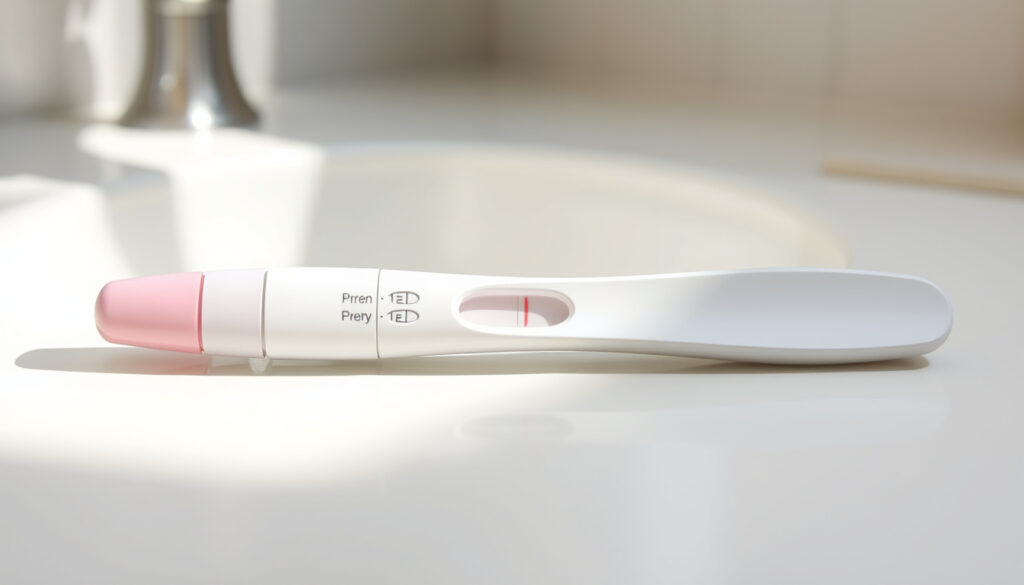
Faint Line on Pregnancy Test: What It Really Means
Anyone who’s watched a pregnancy test develop knows the unique suspense of waiting for that second line. When a faint line appears, it raises immediate questions about whether it’s a positive, a fluke, or something else entirely — and this guide walks through what it actually means, how hCG levels and test timing influence the result, and which steps to take next.
hCG detection threshold in most home tests: 25 mIU/mL · Recommended reading time window: 5–10 minutes · Accuracy rate when used correctly: >99% · Percentage of pregnancies detected on the day of missed period: >99% · Time after implantation to reach 25 mIU/mL hCG: ~3–4 days
Quick snapshot
- A visible colored second line within the reading window indicates hCG detected (First Response (home pregnancy test manufacturer))
- Evaporation lines are colorless or gray and appear after the test dries (Pregmate (test strip brand))
- Home tests detect hCG in urine, not in blood (Cleveland Clinic (leading academic medical center))
- Whether a specific faint line intensity corresponds to an exact hCG level (varies by test batch and urine concentration) (Natural Cycles (FDA-cleared fertility tracking app))
- Whether a faint line alone predicts miscarriage risk without serial blood tests (Natural Cycles (FDA-cleared fertility tracking app))
- hCG first appears in urine ~3–4 days after implantation (Cleveland Clinic)
- Most sensitive tests detect 10–25 mIU/mL; faint lines often appear before missed period (Mayo Clinic (leading U.S. medical research institution))
- Read within the test window – do not evaluate after 10 minutes (Clearblue (test manufacturer))
- Retest after 48 hours to see line progression (Pregmate)
- Confirm with a healthcare provider – blood test or follow-up urine test (Better Health Channel (Victorian government health service))
Six key numbers, one pattern: Faint lines almost always mean pregnancy hormone is present, but intensity alone tells you little about timing or viability.
| Factor | Detail |
|---|---|
| hCG starts being produced | ~6–12 days after ovulation (implantation) |
| Typical sensitivity of home tests | 25 mIU/mL (some 10 mIU/mL) |
| False positive rate | <0.1% when tests are not expired and used correctly |
| Time to read result | 5 minutes (do not read after 10 minutes) |
| hCG doubling time in early pregnancy | Roughly every 48 hours (Pregmate) |
| Accuracy when read correctly | >99% (Cleveland Clinic) |
A faint line is a positive result – you’ve detected hCG. The real question is timing and what to do next.
Can a faint line be negative?
Understanding the difference between a true positive and an evaporation line
- A faint line that appears within the reading window (usually 3–5 minutes) is almost always a true positive. Clearblue (test manufacturer) states: “any positive line, no matter how faint, means the result is pregnant.”
- An evaporation line appears after the urine has dried, typically after 10 minutes, and looks colorless or grayish. Pregmate warns that these should not be interpreted as positive.
- False positives from hCG alone are extremely rare – less than 0.1% with non-expired tests used correctly (Cleveland Clinic).
Why a faint line is almost always positive if read within the time frame
- Home tests detect hCG by binding antibodies to the hormone. Any visible colored line – even a faint one – indicates a successful binding reaction.
- First Response Canada explains that a faint pink or blue second line still means the pregnancy hormone has been detected.
The implication: if you read the test at 4 minutes and a line is there, it’s positive. Treat it as such.
How accurate is a faint pregnancy line?
Accuracy factors: test sensitivity, user error, and timing
- Lab accuracy of home tests exceeds 99% when used as directed (Cleveland Clinic). A faint line does not reduce that accuracy – it simply reflects low hCG concentration.
- Diluted urine (drinking too much water before testing) or testing too early can produce a faint line even when pregnancy is real. The test is still accurate – it found hCG, just a small amount.
- No home test is 100% perfect. Mayo Clinic (leading U.S. medical research institution) recommends confirming with a healthcare provider.
Clinical sensitivity vs. real-world sensitivity
- Manufacturer sensitivity (e.g., 25 mIU/mL) is measured under ideal conditions. Real-world factors – user error, expired tests, improper storage – can reduce performance.
- Cleveland Clinic notes that incorrect use is the main cause of false negatives, not false positives.
The pattern: the test is trustworthy when taken with first-morning urine and read on time. A faint line adds no extra uncertainty.
If you see a faint line but the test dries and later a gray line appears, don’t count it – that’s an evaporation artifact.
Does a faint line mean weak pregnancy?
What hCG level gradients indicate
- Line intensity reflects the concentration of hCG in your urine at that moment. Early pregnancy naturally has low hCG – below 25 mIU/mL for many women before the missed period.
- Natural Cycles (FDA-cleared fertility tracking app) says a faint line “usually means the hCG level is low” – not that the pregnancy is weak.
Faint line does not predict pregnancy viability or strength
- A healthy pregnancy starts with low hCG that doubles every 48 hours. A faint line can be completely normal at 4 weeks.
- Flo (women’s health app with medical review team) notes that a faint positive that does not darken over time may indicate a chemical pregnancy, but one faint line alone is not diagnostic.
Why this matters: don’t panic over a faint line. It’s a snapshot of hCG at one point in time, not a verdict on the pregnancy’s outcome.
How early is a very faint line?
Implantation timing and hCG production
- Implantation occurs 6–12 days after ovulation. hCG production begins immediately, but it takes ~3–4 days for urine levels to reach the detection threshold of most tests (Cleveland Clinic).
- Tests with higher sensitivity (10 mIU/mL) can detect a faint line as early as 8–10 days after ovulation – a few days before your missed period.
Earliest possible detection: 8–10 days after ovulation
- Mayo Clinic advises waiting until the day of your missed period for the most reliable result. Testing earlier increases the chance of a faint line.
- First Response confirms that a faint line “can occur because hCG levels are still low in very early pregnancy.”
The trade-off: testing early gives you an answer sooner, but you’re more likely to see a faint line that may cause anxiety. Waiting a few days usually produces a darker line if the pregnancy is progressing.
How many weeks pregnant is a faint line?
Estimating gestational age from line intensity is unreliable
- Home tests are qualitative – they detect hCG, not measure its exact level. Intensity varies by test brand, urine concentration, and individual biology.
- The same hCG level can produce a different line darkness on different tests. Digital tests show “Pregnant” or “Not Pregnant” regardless of intensity.
hCG doubling time and typical ranges per week
- At 4 weeks (around the time of missed period), hCG can range from 10 to 750 mIU/mL. A faint line is expected at the low end.
- Pregmate notes that hCG often doubles every 1.4 to 2.1 days in early pregnancy. Serial testing over 48–72 hours shows the trend better than a single faint line.
The catch: you cannot determine weeks of pregnancy from a faint line. Use the first day of your last menstrual period or an ultrasound for dating.
A faint line can be both reassuring (you’re pregnant) and frustrating (you don’t know how far along). That’s why follow-up testing matters more than the shade of pink or blue.
What to do after a faint line: A step-by-step guide
Six steps, one goal: confirm the result and get prenatal care early.
- Read the test result at the manufacturer’s specified time – usually 3–5 minutes. Do not interpret after 10 minutes.
- Take a photo of the test for a record. Lighting can affect how the line appears in person.
- Wait 48 hours and test again with first-morning urine. A growing pregnancy should show a darker line. Pregmate recommends retesting in 48–72 hours.
- Check for symptoms – while not reliable, missed period, breast tenderness, nausea, and fatigue may support the result.
- Make a doctor’s appointment for a blood hCG test (quantitative) or a follow-up urine test. Better Health Channel advises confirming any positive result medically.
- If bleeding occurs alongside a faint positive, contact your healthcare provider – it could be implantation bleeding or, rarely, a sign of early miscarriage or ectopic pregnancy. Flo notes that a faint positive that does not darken may indicate a chemical pregnancy.
For anyone in early pregnancy, the clear action is: retest in two days, call your doctor, and avoid jumping to conclusions based on line intensity.
Clarity: What we know and what remains uncertain
Confirmed facts
- A faint line within the reading window is a positive result (Clearblue, First Response)
- Evaporation lines appear after the window and are not positive (Pregmate)
- hCG levels double roughly every 48 hours in early pregnancy (Pregmate)
- False positives from hCG alone are extremely rare (Cleveland Clinic)
What’s unclear
- Whether a specific faint line intensity correlates with exact hCG level (depends on test batch and urine concentration)
- Whether a faint line predicts miscarriage risk without serial hCG blood tests (Natural Cycles notes some faint positives may be associated with chemical pregnancy)
Expert perspectives on faint lines
The strength of the positive test line depends on how much hCG is in your urine. If the line is faint, it usually means that the hCG level is low.
— Clearblue official guidance (Clearblue (test manufacturer))
If a second line appears – even a faint one – the test has detected the pregnancy hormone in your urine.
— First Response statement (First Response (home pregnancy test manufacturer))
A faint line on a pregnancy test indicates low levels of hCG, and it might appear due to diluted urine, early stages of pregnancy or intake of hCG-containing medications.
— Flo.health medical review (Flo (women’s health platform with medical review team))
Summary: What the faint line really tells you
A faint line is a positive test – it means your body is producing hCG. The shade of the line does not measure the strength of your pregnancy, and it cannot tell you how many weeks pregnant you are. What it does tell you is that you have enough hCG to trigger a result. For anyone trying to conceive, the next step is clear: wait 48 hours, retest, and if the line darkens or stays present, contact your healthcare provider for a blood test. If the line fades or you begin bleeding, seek medical advice promptly.
Frequently asked questions
Is a faint line on a pregnancy test always a positive?
Yes, if it appears within the manufacturer’s reading window. Any visible colored line indicates hCG was detected.
What is the difference between a faint line and an evaporation line?
A faint line appears during the reading window and is colored (pink/blue). An evaporation line appears after the window, is colorless or gray, and should not be interpreted as positive.
Can a faint line get darker over time?
Yes. In a progressing pregnancy, hCG doubles every 48 hours, so retesting after 2–3 days usually shows a darker line.
How long after a faint line should I test again?
Wait 48 hours and test with first-morning urine. Testing sooner may not show a visible change.
Does a faint line mean I’m less pregnant?
No. Line intensity reflects current hCG concentration, not pregnancy strength or viability.
Can medications cause a faint line?
Only medications that contain hCG (some fertility treatments) can cause a false positive. Most common medications do not affect home pregnancy tests.
What should I do if I get a faint line but then start bleeding?
Contact your healthcare provider. Bleeding with a positive test can be implantation bleeding or may signal a miscarriage or ectopic pregnancy.
For further reading: What Is Lupus Disease? Symptoms, Causes, and Life Expectancy – understanding how the body’s immune system can affect pregnancy. Also see Solpadol 30mg/500mg Dose: Official Safety Guide for information on medication safety during pregnancy.
More related posts
 Athletic Bilbao vs Man United Lineups Today (8 May 2025)
 Package Holidays From Dublin – Best Deals From €289pp
 Man U vs Grimsby: Shocking 12-11 Penalty Loss in Carabao Cup
 My Parents Are Aliens: Plot, Cast Changes & Ending Guide
 Houses for Sale Near Me: Cheapest Locations & Timing in 2026
 Richest Man in the World – Elon Musk Tops 2025 Rankings
 HL Club Playa Blanca: Honest Reviews, Rooms & Location
 King Size Duvet Covers in Ireland: Sizes, Sales & Deals