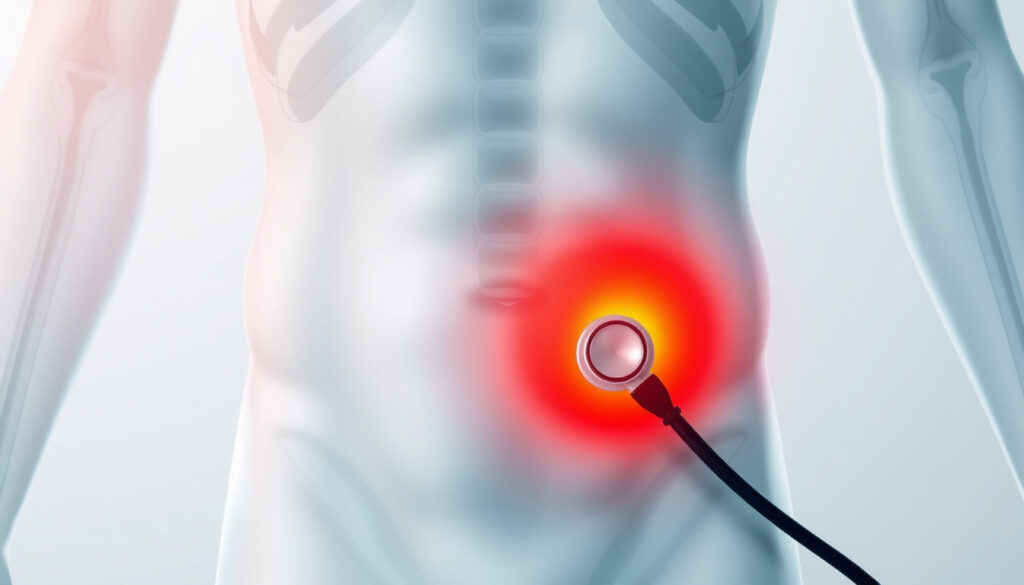
Lower Left Abdominal Pain: Causes and Red Flags
Few things grab your attention quite like a sudden twinge in your lower left abdomen. That spot below your belly button and off to the side is a crossroads for several organs, so pain there can mean anything from a harmless gas bubble to something requiring urgent care.
Diverticulosis prevalence (adults over 60): ~50% · Global IBS prevalence: 10–15% · Abdominal pain share of U.S. ER visits: 5–10%
Quick snapshot
- Gas and constipation account for most benign cases (Cleveland Clinic (major health system))
- Diverticulitis is the most common serious colonic cause (American Family Physician (clinical journal))
- Why some people develop severe diverticulitis while others stay asymptomatic (NCBI Bookshelf / StatPearls (academic medical resource))
- The exact cause of irritable bowel syndrome (Medical News Today (health news publisher))
- Pain lasting more than 24–48 hours without improvement warrants evaluation (Cleveland Clinic (major health system))
- If red flags are absent, home care (hydration, fiber, OTC gas relief) may suffice for mild symptoms (Medical News Today (health news publisher))
- Persistent or worsening pain requires professional diagnosis, often with imaging (American Family Physician (clinical journal))
The breakdown below shows the most common causes and their key distinguishing features.
| Most common cause | Gas and constipation |
| Most serious common cause | Diverticulitis (infection of colon pouches) |
| Gender-specific emergency in women | Ectopic pregnancy |
| Key red flag | Pain with fever, vomiting, or inability to pass stool/gas |
| Typical treatment for diverticulitis | Antibiotics and liquid diet; severe cases may need surgery |
Why does my left lower abdomen hurt?
Gas and constipation
The most frequent culprits are also the least serious. Trapped gas or stool can stretch the colon wall, producing a crampy, shifting ache that often resolves after a bowel movement. No fever, no vomiting — just discomfort that comes and goes. According to Cleveland Clinic (major health system), this pattern is the most common reason people search “lower left abdominal pain.”
Irritable bowel syndrome (IBS)
IBS affects 10–15% of the global population, per NCBI Bookshelf (StatPearls, clinical reference). The pain is chronic, cramping, and often tied to bowel habits — better after a movement, worse after eating. Bloating is a frequent companion. The exact cause remains unclear, but the pattern is recognizable.
Diverticulosis and diverticulitis
Diverticulosis — small pouches in the colon wall — becomes increasingly common with age. Cleveland Clinic (major health system) notes that about 50% of adults over 60 have them. Most never cause trouble. But when those pouches become inflamed or infected, the result is diverticulitis: persistent, sharp pain low on the left, often with fever and nausea. American Family Physician (clinical journal) says this triad — left lower quadrant pain, fever, leukocytosis — is the classic presentation.
Menstrual cramps and endometriosis (females)
For women of reproductive age, cyclical pain tied to the menstrual cycle is common. Providence (health system blog) highlights that ovarian cysts and endometriosis can cause sharp or dull lower left pain, especially around ovulation or menstruation.
Kidney stones
A stone passing through the left ureter produces sharp, radiating pain that may start in the flank and move downward. NCBI Bookshelf (StatPearls, clinical reference) mentions it can be mistaken for colonic pain. Blood in the urine is a telltale sign.
Most lower left abdominal pain is benign — gas, constipation, mild IBS. But the same location can announce a perforated diverticulum or an ectopic pregnancy. The difference is in the pattern and the company symptoms.
What organ is in the lower left abdomen?
Sigmoid colon
The sigmoid colon is the S-shaped segment of the large intestine that sits just above the pelvic brim on the left. It’s the most common source of lower left abdominal pain because it’s where diverticula most often form. American Family Physician (clinical journal) identifies it as the primary site for acute diverticulitis.
Left ovary and fallopian tube (in females)
For women, the left ovary and tube are nearby residents. Cysts, torsion, or an ectopic pregnancy in this location produce pain that can feel identical to a colonic problem. Providence (health system blog) stresses that ectopic pregnancy must be ruled out in any woman of reproductive age with lower abdominal pain.
Left ureter
The ureter carries urine from the left kidney to the bladder. A stone passing through triggers sharp, wave-like pain that often radiates to the groin. NCBI Bookshelf (StatPearls, clinical reference) lists hematuria as a key clue.
Part of the small intestine
The small intestine loops into the lower left quadrant, but significant pain from this area is less common. Obstruction or inflammation here usually produces more diffuse or central symptoms.
Pelvic bones and muscles
Musculoskeletal pain — from a strain, hernia, or pelvic bone issue — can mimic organ pain. NCBI Bookshelf (StatPearls, clinical reference) notes that abdominal wall causes are often overlooked in initial assessments.
The trade-off: The lower left abdomen is a tight neighborhood. The same stretched nerve can come from colon, ovary, ureter, or muscle. Anatomy alone won’t tell you — context and accompanying symptoms will.
When should I worry about left side abdominal pain?
The three red flags in abdominal pain
NSW Health (Agency for Clinical Innovation, government guideline) defines the core triad: severe pain (especially if it wakes you from sleep), fever (indicating infection or inflammation), and vomiting or inability to pass stool or gas (suggesting obstruction). Any one of these should prompt a medical call.
Signs of peritonitis or obstruction
A rigid, board-like abdomen with guarding is the hallmark of peritonitis — an inflammation of the membrane lining the abdominal wall. Cleveland Clinic (major health system) describes this as a “swollen, distended, or rigid” abdomen. It’s a 911-level sign.
Pain with bleeding
Blood in stool or urine turns a manageable problem into a potential emergency. Cleveland Clinic (major health system) lists this as a clear warning to seek evaluation. Diverticulitis can cause bleeding; so can a kidney stone. Either way, it needs a look.
Pain that stops you mid-sentence or keeps you from lying still deserves immediate attention. Benign pain lets you shift positions and find relief. Peritonitis or obstruction does not.
Sudden severe pain
“Sudden onset severe pain” is a classic presentation of perforation, rupture (ectopic pregnancy, ovarian cyst), or torsion. Medical News Today (health news publisher) says if the pain came on “like a switch” and hasn’t let up, don’t wait.
What this means: Red flags are not subtle. If you’re asking “should I worry,” and your pain comes with fever, vomiting, blood, or a rigid belly — you already have your answer. Get to a doctor.
What does diverticulitis pain feel like?
Location and nature of pain
Diverticulitis pain is typically constant, sharp, or cramping, localized to the lower left abdomen. American Family Physician (clinical journal) describes it as “persistent and localized.” Unlike gas pain, it doesn’t shift. Unlike IBS, it doesn’t reliably improve with a bowel movement. It often worsens with movement or applying pressure over the area.
Associated symptoms
Fever and chills are common when infection is present. Medical News Today (health news publisher) notes that nausea, change in bowel habits (constipation or diarrhea), and loss of appetite are frequent companions. If you have lower left pain plus a fever, diverticulitis is near the top of the differential.
Diverticulosis vs. diverticulitis
Diverticulosis — the pouches exist — is usually asymptomatic. Diverticulitis — the pouches are infected — is not. The transition from silent pouches to active inflammation is not predictable, but NCBI Bookshelf (StatPearls, clinical reference) says that once you have diverticulitis, recurrence risk rises.
Why this matters: If your pain is sharp, stays in one spot, and you’re running a fever — think diverticulitis. A clear liquid diet and antibiotics can often treat it, but it always needs a diagnosis first.
What causes lower left abdominal pain in women and men?
Women: ovarian cysts, endometriosis, pregnancy-related pain
Ovarian cysts can rupture or twist, causing sudden sharp pain. Providence (health system blog) says ectopic pregnancy is the most dangerous gynecologic cause — it can present with lower left pain, vaginal bleeding, and a missed period. Any woman of reproductive age with these symptoms needs a pregnancy test and likely an ultrasound.
Men: inguinal hernia, prostatitis (rare)
Inguinal hernias are more common in men and can cause a dull ache in the lower left groin, especially with lifting or straining. NCBI Bookshelf (StatPearls, clinical reference) lists it as a differential for left lower quadrant pain. Prostatitis is less common but can radiate discomfort into the lower left side.
Both: UTIs, kidney stones, IBS, diverticulitis
Many causes cross gender lines. Urinary tract infections, kidney stones, IBS, and diverticulitis affect both men and women. American Family Physician (clinical journal) emphasizes that the diagnostic approach should consider the full anatomical picture, not just the colon.
For women: if you’re of childbearing age and have lower left pain plus a late period, ectopic pregnancy is a life-threatening possibility until proven otherwise. For men: a reducible groin lump with pain suggests hernia.
The implication: Gender shapes the differential. But the overlap — IBS, diverticulitis, kidney stones — is broad. A physician’s evaluation remains the only reliable way to separate the common from the critical.
ubiehealth.com, cancertherapyadvisor.com, syracuseherniacenter.com, ems1.com, pubmed.ncbi.nlm.nih.gov, pmc.ncbi.nlm.nih.gov
For a more detailed breakdown by sex, you can explore gender-specific causes of lower left abdominal pain on the Nation Voice website.
Frequently asked questions
Can stress cause lower left abdominal pain?
Yes. Stress can exacerbate IBS symptoms and increase gut sensitivity. While stress alone rarely causes structural damage, it can amplify pain perception and bowel irregularity (NCBI Bookshelf (StatPearls, clinical reference)).
Is lower left abdominal pain a sign of ovarian cyst?
It can be. Ovarian cysts — fluid-filled sacs on the ovary — often cause no symptoms, but a large cyst or one that ruptures can produce sharp, localized lower left pain (Providence (health system blog)).
How is lower left abdominal pain diagnosed?
Diagnosis starts with a history and physical exam. Depending on the findings, doctors may order blood tests, urine analysis, CT scan, ultrasound, or colonoscopy (American Family Physician (clinical journal)).
What tests are done for lower left abdominal pain?
Common tests include complete blood count (CBC) for infection, C-reactive protein (CRP), urinalysis for kidney stones or infection, pregnancy test for women, and CT abdomen/pelvis with contrast for acute evaluation (NSW Health (Agency for Clinical Innovation, government guideline)).
Can lower left abdominal pain be a sign of cancer?
Rarely, but colon cancer can present with left-sided abdominal pain, especially if there is a change in bowel habits, blood in stool, or unexplained weight loss. Most causes of lower left pain are benign (Medical News Today (health news publisher)).
Does lower left abdominal pain always require a doctor visit?
No. Mild, intermittent pain without red flags — especially if it resolves with passing gas or stool — can often be managed at home with hydration, fiber, and OTC gas relief (Cleveland Clinic (major health system)).
What home remedies help lower left abdominal pain?
Hydration, gentle heat packs, avoiding heavy meals, and consuming soluble fiber (e.g., oatmeal) can help mild gas/constipation pain. Avoid NSAIDs if diverticulitis is suspected, as they can increase bleeding risk (Medical News Today (health news publisher)).
For anyone experiencing lower left abdominal pain, the decision to wait or act depends on one thing: company symptoms. Pain that travels, shifts, and resolves with a bathroom visit is almost certainly benign. Pain that stays in one spot, worsens, and brings fever, vomiting, or blood — that’s a signal for urgent care. For the average reader, the safest move is to treat mild symptoms at home for 24 hours, and if the pain persists or worsens, see a doctor. The consequences of ignoring a perforated diverticulum or an ectopic pregnancy far outweigh the inconvenience of a false alarm.
More related posts
 Jeeps for Sale Ireland: Used, Cheap & 4×4 Buyer’s Guide
 1 Euro to Pound Exchange Rate: Live EUR to GBP Converter
 The Fish Elizabeth Bishop – Summary, Analysis & Symbolism
 Chine e Calendar Baby Gender 2026: How It Work and Accuracy
 Garda Diarmuid Ó Tuairisg dies suddenly: tributes pour in
 Easter Island Garden Centre: Family-Run Plant Haven
 Manchester United vs West Ham: Score, Head-to-Head & Players
 Land for Sale Cork: Guide to Farms & Planning Permission