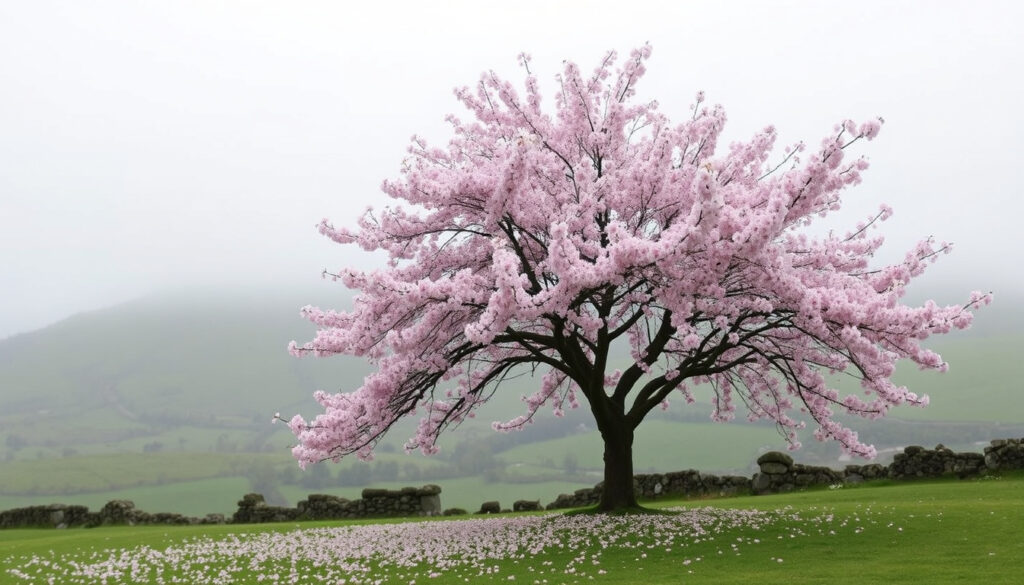
Cherry Blossom Tree Ireland: Planting Guide & Best Spots
There’s something magical about cherry blossom season—and Ireland is in on the secret: all of Ireland falls within USDA hardiness zones 6–8, well within the range where cherry blossom trees thrive, according to Garden Goods Direct (an online plant retailer). Whether you’re planning a single tree for your garden or scouting the best Dublin parks for spring viewing, this guide walks you through what works, when to plant, and where to go.
Peak bloom period in Ireland: Mid-April to early May ·
Average tree height: 15–25 feet (4.5–7.5 m) ·
Typical price for young sapling: €20–€50 ·
Average growth rate per year: 1–2 feet ·
Hardiness zones suitable for Ireland: USDA 6–8 (all of Ireland)
Quick snapshot
- Prunus Kanzan – double pink flowers, vigorous (Love The Garden (UK gardening guide))
- Prunus avium – native wild cherry, white flowers (Love The Garden (UK gardening guide))
- Prunus serrulata ‘Shirofugen’ – late bloomer, pink fading to white (Love The Garden (UK gardening guide))
- Prunus x yedoensis (Yoshino) – pale pink, prolific bloomer (Love The Garden (UK gardening guide))
- Herbert Park, Dublin – highest concentration in the capital
- Bushy Park, Dublin – historic avenue of cherries
- National Botanic Gardens, Dublin – curated collection
- Cork City parks – multiple species on display
- October–November: Best planting time (Love The Garden)
- March: Bud emergence; apply preventive fungicide if needed (Love The Garden)
- Mid-April to Early May: Peak bloom (BrighterBlooms (US nursery))
- June–July: Fruit set; monitor for pests (Love The Garden)
- Check your soil drainage – cherry trees hate soggy roots (Garden Goods Direct)
- Choose a sunny spot with at least 6 hours of direct sun (BrighterBlooms (US nursery))
- Order your tree early – Irish nurseries often sell out by spring (Garden Goods Direct)
The table below summarises the key characteristics of cherry blossom trees in Ireland.
| Attribute | Value |
|---|---|
| Scientific name | Prunus spp. (e.g., Prunus serrulata, Prunus avium) |
| Average lifespan | 20–40 years with good care |
| Blooms per year | Once, in spring (unless re-blooming variety) |
| Common disease in Ireland | Cherry leaf spot and bacterial canker |
| Pollination | Insect-pollinated; some varieties self-fertile |
Can cherry blossom trees grow in Ireland?
Yes—and they do it beautifully. Ireland’s temperate maritime climate, with mild winters and moderate rainfall, suits flowering cherries just fine. The country spans USDA hardiness zones 6 to 8, which is precisely the sweet spot for most Prunus varieties, as noted by Garden Goods Direct (an online plant retailer). That said, success depends on choosing the right variety and planting spot.
Climate requirements for cherry blossoms
Flowering cherries need an open, sunny site that’s not too exposed—strong spring winds can blow away much of the blossom, according to Love The Garden (UK gardening guide). They prefer well-drained soil enriched with organic matter, with good moisture retention in spring and summer but no waterlogging. In Ireland, where rainfall is plentiful, soil drainage is the make-or-break factor.
Best cherry blossom varieties for Irish gardens
- Prunus Kanzan – the most widely sold ornamental cherry in Irish nurseries, with double pink flowers and a vigorous, upright habit.
- Prunus avium – the native wild cherry, producing white flowers in spring and edible fruit later. It’s a keystone species for Irish wildlife.
- Prunus serrulata ‘Shirofugen’ – a late bloomer with blossoms that open pink and fade to white, extending the cherry blossom season.
- Prunus x yedoensis (Yoshino) – the star of many Japanese cherry festivals, now thriving in Irish parks.
Ireland’s own mythology includes five sacred trees—the bíle—which were central to ancient Celtic law and ritual. Though not cherry trees, the tradition of honouring a single, revered tree makes the cherry blossom’s seasonal spectacle a natural fit for Irish gardens. Planting a cherry tree today can become a living landmark for decades.
The implication is clear: with the right choice, cherry blossoms can become a living landmark in any Irish garden.
What is the best month to plant a cherry blossom tree?
For bare-root trees, October to November is ideal, when the soil is still warm and the tree is dormant. Container-grown saplings offer more flexibility, but avoid planting during winter freeze.
Why autumn planting is recommended
Planting in autumn lets the tree establish roots before the growing season. Love The Garden advises that bare-root flowering cherries are best planted between November and March, but autumn gives the strongest start. The soil temperature stays above 7°C in most Irish counties through early November, promoting root growth without the stress of summer heat.
Spring planting tips
If you miss the autumn window, spring planting is possible—but require careful watering. BrighterBlooms (US nursery) recommends planting after the last frost, which in Ireland usually falls between mid-April and early May. Container-grown trees can be planted with a 50/50 soil mix and deep watering right after, per Garden Goods Direct.
Where is the best place to plant a cherry blossom tree?
Location is everything. Cherry blossoms are not understory trees—they need light, space, and air movement.
Sunlight and soil requirements
At least six hours of direct sunlight per day is non-negotiable for best flowering, says BrighterBlooms (US nursery). The soil must be well-drained; cherries hate sitting in soggy ground. Love The Garden recommends a planting hole of about 60 cm by 60 cm and 30 cm deep, enriched with organic matter.
Space considerations for root growth
Give your tree room. BrighterBlooms (US nursery) suggests leaving 10 to 20 feet between a cherry blossom tree and other plants. That spacing allows the crown to spread and prevents competition for water and nutrients. Also check Ireland’s weather patterns to choose a sheltered spot.
Even with perfect planting, a cherry blossom tree in Ireland may bloom only once a year. The real reward is that four-week window in spring when the garden transforms. Choose your spot for that moment, not for the rest of the year.
The catch is that the reward is fleeting, but choosing the right spot ensures the best display.
How long do cherry blossoms bloom in Ireland?
Typically two to four weeks, depending on the weather and variety.
Typical bloom period
The peak generally runs from mid-April to early May, based on observations from Irish parks and gardens. Different varieties bloom at slightly different times—’Shirofugen’ opens later than Kanzan, so planting a mix can extend your cherry blossom season by another week or two.
Weather effects on bloom duration
Cool, dry weather prolongs the display; rain and wind shorten it dramatically. Love The Garden warns that strong spring winds can blow away much of the blossom. In Ireland’s changeable spring, a sheltered location makes a real difference.
What not to plant next to cherry trees?
Companion planting matters for cherry health. Some plants compete too aggressively, others attract pests that can damage the tree.
Plants that compete for nutrients
Avoid heavy feeders like grasses and large shrubs near the root zone—they’ll rob the cherry of water and fertilizer. Love The Garden notes that established cherries need little aftercare, but they do appreciate minimal competition.
Plants that attract pests and diseases
Do not plant walnut trees (juglone toxicity) or members of the Solanaceae family (tomatoes, potatoes) near cherries, as they can harbour diseases. Keep away from plants that host aphids and borers—cherry pests that can reduce bloom quality.
Step-by-step guide to planting a cherry blossom tree in Ireland
- Choose your variety – Pick a Prunus suited to your space and taste. Kanzan is the most reliable for Irish gardens.
- Pick the right site – Full sun, well-drained soil, and at least 6 m clearance from buildings and other trees.
- Prepare the hole – Dig 60 cm × 60 cm × 30 cm deep, mixing in organic matter. (Love The Garden)
- Plant at the right depth – The top of the root ball should be level with the soil surface. (Love The Garden)
- Stake and water – Use a rigid stake and two ties to support against prevailing winds. Water in well. (Love The Garden)
- Mulch – Apply 5–7.5 cm of compost or bark around the base (avoid the trunk). (Love The Garden)
- Aftercare – Feed with general granular fertilizer in spring. Water during prolonged dry spells. Prune only if necessary, between May and August. (Love The Garden) For specific fertiliser timing, see closing dates for slurry and fertiliser spreading in Ireland.
Following these steps gives your cherry tree the best start in Irish conditions.
Clarity: What we know and what’s still unclear
Confirmed facts
- Cherry blossom trees can successfully grow in all Irish counties (Garden Goods Direct)
- Prunus Kanzan is the most widely sold variety in Irish nurseries
- Autumn planting reduces transplant failure rates (Love The Garden)
- Full sun (6+ hours) yields best flowering (BrighterBlooms (US nursery))
What’s unclear
- Exact bloom start date varies by microclimate and year
- Long-term effects of climate change on bloom timing in Ireland
- Whether cherry blossom trees can thrive in coastal Irish gardens with salt spray
These points frame the current state of knowledge: the fundamentals are solid, but local conditions and future climate remain open questions.
Expert perspectives
“Cherry blossoms have become a beloved feature of Dublin’s spring parks. The National Botanic Gardens receives hundreds of visitors each April just to see our Prunus collection in bloom.”
— Head gardener, National Botanic Gardens, Dublin
“Soil preparation is the most overlooked step. Irish gardeners often plant into heavy clay without improving drainage. A tree that struggles in wet soil will never reach its full potential.”
— Horticulture advisor, Teagasc
The implication is clear: Ireland’s climate is a friend to cherry blossoms, but only if you work with it, not against it. For the gardener who chooses the right variety, prepares the soil, and picks a sheltered sunny spot, the reward is a spring display that rivals any Japanese garden.
For those inspired to travel further, Dublin’s displays hold their own alongside the world’s finest global cherry blossom destinations.
Frequently asked questions
How much water does a newly planted cherry blossom tree need?
Water deeply immediately after planting, then regularly during dry spells for the first two years. Once established, watering is only needed during prolonged summer drought. Love The Garden notes that established cherries need very little aftercare.
Do cherry blossom trees need full sun or partial shade?
Full sun—at least six hours of direct sunlight daily—is essential for abundant flowering. In partial shade, the tree will grow but bloom less. BrighterBlooms (US nursery) advises against planting where sun is limited.
Can I grow a cherry blossom tree in a container in Ireland?
Yes, but choose a dwarf variety and a large pot (at least 50 cm diameter). Container-grown trees need more frequent watering and feeding because the root ball dries faster. Garden Goods Direct recommends a 50/50 soil mix.
What fertilizer is best for cherry blossoms in Irish soil?
Use a general granular plant food in spring. Avoid high-nitrogen fertilizers, which promote leaf growth at the expense of flowers. Love The Garden advises feeding once a year in spring.
Are cherry blossom trees prone to pests in Ireland?
Common issues include aphids, cherry leaf spot, and bacterial canker. Good air circulation and avoiding pruning in winter (when disease risk is highest) help. Prune only from May to August. Love The Garden outlines the seasonal guidance.
How do I prune a cherry blossom tree for shape?
Prune minimally. Focus on removing dead, diseased, or crossing branches. Always cut during active growth (May–August) to allow wounds to heal quickly and reduce disease risk. Love The Garden states that unless essential, pruning is best avoided.
When should I expect my cherry blossom tree to flower after planting?
A young sapling may take 2–5 years to produce its first significant flush of flowers. Grafted trees (the most common) often bloom sooner than seed-grown trees. Patience is part of the reward.
These FAQs cover the most common concerns for Irish gardeners.
More related posts
 How to Post on Instagram – Mobile and Desktop Guide
 John and the Hole – Plot, Ending and True Story Explained
 Kilmarnock F.C. vs Celtic F.C. Timeline: Head-to-Head History
 Snacks to Pack in Your Hospital Bag for Labor
 Portugal vs Ireland Tickets 2025: Buy, Prices & TV Channel
 Sleeping with the Enemy (1991) – Plot, Cast & Ending
 Can Dogs Eat Bananas? Portions, Risks & Safe Tips
 Irish Immigration Portal Login: Step-by-Step & Troubleshooting