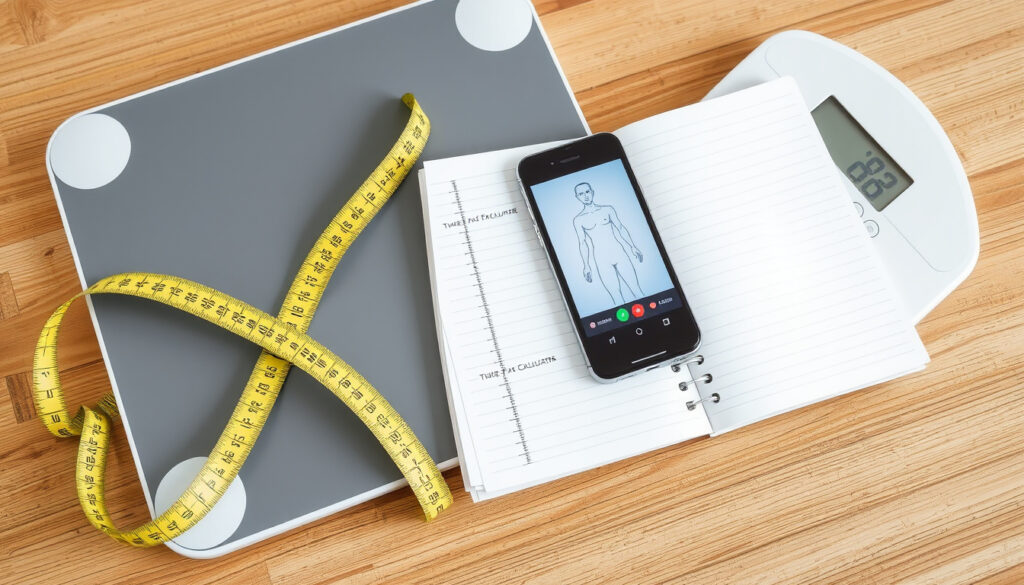
Body Fat Percentage Calculator: Navy Method at Home
If you’ve ever wondered whether your body fat percentage is in a healthy zone, you’re not alone. The number on the scale only tells part of the story — with just a tape measure, you can use the same method the U.S. Navy relies on.
Essential fat minimum (men): 2–5% ·
Essential fat minimum (women): 10–13% ·
Healthy range (men 20–39): 8–19% ·
Healthy range (women 20–39): 21–33% ·
Navy method used by: U.S. military for body composition assessment
Quick snapshot
- The Navy method estimates body fat within ±3–5% of DEXA scans (RippedBody (fitness resource))
- Essential fat for survival is 2–5% for men, 10–13% for women (Calculator.net (online calculator platform))
- ACE publishes widely accepted healthy body fat ranges by activity level (RippedBody (fitness resource))
- Which single home method is universally most accurate across all demographics
- How much hydration affects consumer bioelectrical impedance scale readings
- Whether Navy ‘obese’ cutoffs directly equal general health risk thresholds
- 1970s: U.S. Navy develops circumference equation at Naval Health Research Center (Omni Calculator (health calculator platform))
- More validation studies comparing Navy method to DEXA in diverse populations
- Integration of Navy formula into more consumer health apps
Six key facts lay the foundation for understanding body fat numbers. Healthy ranges differ by gender and age, as shown below.
| Category | Men | Women |
|---|---|---|
| Essential fat | 2–5% | 10–13% |
| Athletes | 6–13% | 14–20% |
| Fit | 14–17% | 21–24% |
| Acceptable | 18–24% | 25–31% |
| Obese (Navy, under 30) | >22% | >30% |
| Obese (ACE guidelines) | 25%+ | 32%+ |
How Do I Calculate My Body Fat Percentage?
Two primary methods dominate home calculation: the U.S. Navy circumference-based formula and the simpler BMI-based estimate. Each has strengths and trade-offs.
Using the U.S. Navy Method
- Men: %BF = 495 / (1.0324 − 0.19077 × log₁₀(waist − neck) + 0.15456 × log₁₀(height)) − 450
- Women: %BF = 495 / (1.29579 − 0.35004 × log₁₀(waist + hip − neck) + 0.22100 × log₁₀(height)) − 450
- Requires only height, neck, waist (and hip for women) measured with a flexible tape
- Developed at the Naval Health Research Center in San Diego
The Navy method trades a bit of convenience for much better accuracy than BMI. For a home user willing to take three careful measurements, it delivers results within striking distance of a DEXA scan.
Using the BMI Method
- BMI = weight (kg) / height (m)²; then plug into an age- and sex-adjusted body fat formula
- Advantage: zero equipment, instant result
- Drawback: systematically overestimates body fat in muscular people and underestimates in older adults with low muscle mass
The implication: BMI-based calculators give a rough starting point, but the Navy method is far more reliable for tracking real changes in body composition.
Can I Measure Body Fat at Home?
Yes, with at least three practical options: a tape measure for the Navy method, skinfold calipers, or bioelectrical impedance scales. The best choice depends on your budget and how much time you’re willing to invest.
How to use a tape measure for the Navy method
- Measure neck at the base, just below the Adam’s apple, with tape level (LibreTexts (open educational resource))
- Men: measure waist at navel level; women: measure waist at the narrowest part of the abdomen
- Women also need hip circumference at the widest part of the glutes, feet together
- Take each measurement three times and average the results for consistency
How to use skinfold calipers
- Measure skinfold thickness at 3 to 7 standard body sites (e.g., chest, abdomen, thigh for men; triceps, suprailiac, thigh for women)
- Requires trained technique and consistent site marking
- Low-cost calipers (plastic) are less accurate than metal spring-loaded models
Accuracy of home measurement methods
- Navy tape method: ±3–4% error relative to DEXA (Bony to Beastly (fitness site))
- Caliper method (Jackson-Pollock 3-site): ±3–5% in trained hands
- Consumer BIA scales: error may exceed 5–8% depending on hydration and recent meals
The trade-off: the Navy tape method is the most cost-effective, requiring only a tape measure and delivering accuracy comparable to calipers without the learning curve.
What Body Fat Percentage Is Healthy?
Healthy body fat ranges depend heavily on gender, age, and activity level. The American Council on Exercise (ACE) publishes the most commonly referenced guidelines (ACE (fitness certification authority)).
Body fat percentage chart for men
- Essential fat: 2–5%
- Athletes: 6–13%
- Fit: 14–17%
- Acceptable: 18–24%
- Obese: 25%+
Body fat percentage chart for women
- Essential fat: 10–13%
- Athletes: 14–20%
- Fit: 21–24%
- Acceptable: 25–31%
- Obese: 32%+
Understanding essential vs. storage body fat
Essential fat is the minimum required for basic physiological function — insulating organs, hormone regulation, and cell structure. Storage fat accumulates for energy reserves. Women naturally carry more essential fat for reproductive functions, which is why their healthy range starts higher.
Why this matters: falling below essential fat levels can trigger hormonal disruptions and health complications, even if the mirror shows a lean physique.
What Is the US Navy Body Fat Method?
Developed in the 1970s by researchers at the Naval Health Research Center, the Navy circumference method was created for fast, non-invasive body composition screening of large numbers of service members.
Navy circumference measurement protocol
- Measurements taken in minimal clothing (e.g., PT uniform or medical gown)
- Height recorded without shoes
- Neck, waist, and hips (for women) measured with a non-stretchable tape
- All readings taken in inches or centimeters to 0.5 increments
- The formula uses logarithmic relationships to estimate body density, then converts to body fat percentage
Navy body fat standards for enlistment
- Maximum allowable body fat for males 18–21: 22%
- Maximum allowable for females 18–21: 33%
- Standards increase slightly with age; males over 40: up to 26%; females over 40: up to 36% (per MyNavyHR (U.S. Navy personnel office))
- Service members exceeding the limit enter the Body Composition Assessment (BCA) program and must meet improvement goals
The pattern: the Navy’s own standards are generally stricter than civilian health guidelines, reflecting fitness requirements for operational readiness.
What Does 20% Body Fat Look Like?
Visual descriptions help translate a number into a real-world appearance. At 20% body fat, the silhouette differs noticeably between men and women.
Physical appearance at 20% body fat for men
- Muscle definition is less distinct; no visible abdominal separation
- Some fullness in the lower abdomen; love handles may be slight
- No visible veins on arms or torso
- Overall shape: soft but not overweight
Physical appearance at 20% body fat for women
- Appears lean and healthy, not extremely muscular
- Waist-to-hip ratio typically below 0.80
- Some curvature in hips and thighs preserved
- Commonly seen in fitness models and active women
The catch: body fat percentage alone doesn’t capture muscle mass or fat distribution. Two people at 20% can look completely different depending on where they store fat and how much muscle they carry.
How to Measure Body Fat at Home: Step-by-Step Guide (Navy Method)
Follow these steps to get a reliable measurement using only a flexible tape measure.
- Gather your tools: a non-stretchable tape measure (cloth or metal), a pen, paper, and a calculator (or open the body fat calculator at Calculator.net).
- Measure your height without shoes, standing straight against a wall. Record in inches or centimeters. (Need a conversion? See our height conversion guide.)
- Measure your neck: place the tape just below the laryngeal prominence (Adam’s apple) with the tape level all around.
- Measure your waist (men): at the level of the navel, with abdomen relaxed.
- Measure your waist and hips (women): waist at the narrowest part of the abdomen; hips at the widest part of the glutes, feet together.
- Take each measurement three times and use the average.
- Enter the numbers into a Navy method calculator or apply the formula manually. The result is your estimated body fat percentage.
For best consistency, measure in the morning before eating, drinking, or exercising. Record the date so you can track changes over time.
The Navy method assumes a certain average bone structure and fat distribution. Individuals with very high muscle mass or unusual body shapes may see larger errors. Always treat the result as an estimate, not a medical diagnosis.
Confirmed facts
- U.S. Navy method provides estimates with ±3–5% error
- Essential body fat range for survival is 2–5% for men, 10–13% for women
- American Council on Exercise publishes widely accepted healthy body fat ranges
- Navy circumference method uses only tape measure (height, neck, waist, hip)
What’s unclear
- Which single home measurement method is universally most accurate across all demographics
- Precise error margin of consumer bioelectrical impedance scales under varying hydration states
- Whether Navy standards for ‘obese’ directly translate to general health risk thresholds
- How well the Navy method performs in elderly or very muscular populations
Expert Perspectives
“The U.S. Navy circumference method is one of the most practical and validated approaches for estimating body fat without expensive equipment.”
— American Council on Exercise (fitness certification authority)
“For most people, the Navy formula will get you within about 3–4% of your true body fat percentage.”
— Bony to Beastly (fitness resource)
“To get accurate results with the tape measure method, take each measurement three times and use the average.”
— RippedBody (fitness resource)
The takeaway for anyone tracking body fat: the Navy method is your best bet for a free, repeatable, and reasonably accurate home measurement. For serious athletes or clinical settings, DEXA or hydrostatic weighing remains the gold standard. But for everyday health monitoring, a tape measure and a good calculator are all you need.
Related reading: **5 Foot 1 in cm: 154.94 cm Exact Conversion & Guide** · **Is Guinness Good for You? Health Facts & Myths**
Once you’ve calculated your body fat percentage, consult a body fat percentage ranges to see where you fall in the healthy spectrum.
Frequently asked questions
How accurate is the U.S. Navy body fat method?
It has an error margin of about 3–5% compared to DEXA scans, making it one of the most accurate home-based methods available.
Can I calculate body fat percentage using only weight and height?
Yes, the BMI method provides an estimate, but it is less accurate for muscular individuals and older adults.
What is the best time of day to measure body fat?
Measure in the morning before eating, drinking, or exercising for the most consistent results.
Do body fat scales work?
Yes, but accuracy depends on hydration, food intake, and the quality of the device. Consumer BIA scales typically have larger error margins than the Navy tape method.
Is 30% body fat dangerous?
For women over 30%, and men over 25%, health risks for chronic disease increase significantly according to ACE guidelines.
How often should I measure body fat percentage?
Every 2 to 4 weeks is sufficient to track meaningful changes. Measuring more frequently often yields noise due to hydration and food fluctuations.
More related posts
 English to Malayalam Translation: Free Tools & Guides
 What Is the Book of Kells – History, Art and Significance
 Houses for Sale Near Me: Cheapest Locations & Timing in 2026
 Dead Poets Society Cast: Ages, Fame, and Where They Are Now
 Paddy Ryan Car Sales: Used Cars in Thurles, Tipperary
 Colm Meaney Movies and TV Shows: Complete Filmography
 The Bear Season 5: Final Season Confirmed, Filming Wrapped
 U19 Cricket World Cup Standings 2026: Live Points Table